

Just about two weeks ago, Hampshire College declared it was closing. That means we can finally create Hampshire College.
A college is on the market. That’s rare and usually it only happens when the school's model doesn’t work. Hampshire is a fixer-upper in terms of management, but it’s got great bones. I should know, because I spent four years as a student there and two as a professor. If you care about credential inflation, colleges that optimize for rankings instead of learning, and the collapse of trust in higher education, this is your chance to help.
It’s not every day that you can save a campus and an institution that would cost $700M+ to build from scratch, for the measly low price of ~$175M. We have a once-in-a-generation opportunity to buy a 800-acre campus for a fraction of replacement cost. You cannot build this again, at any price, on any timeline. Try getting the permits to assemble 800 contiguous acres in Amherst today.
The deadline is September 2026, Hampshire’s tender date, when it would be on the hook for buying its bonds back. After that, the situation becomes significantly more complicated. The discussion about selling the campus is already underway, and things may start happening in a matter of weeks. Now is the time to move.
We can relaunch Hampshire with the financial foundation the original institution never had, and prove that this model is viable when properly managed. Don’t think of it as rescuing a failed institution. This is about building a new institution on the most valuable real estate in experimental education. This is also for parents who worry about watching their kids disappear into the credential machine. Hampshire is the alternative: a bet that your kid is ready to do original research, and shouldn’t waste their youth on grades and transcripts.
If you have capacity at the $10M+ level and this interests you, email me at <ethanludwinpeery@gmail.com>. But first, read on:
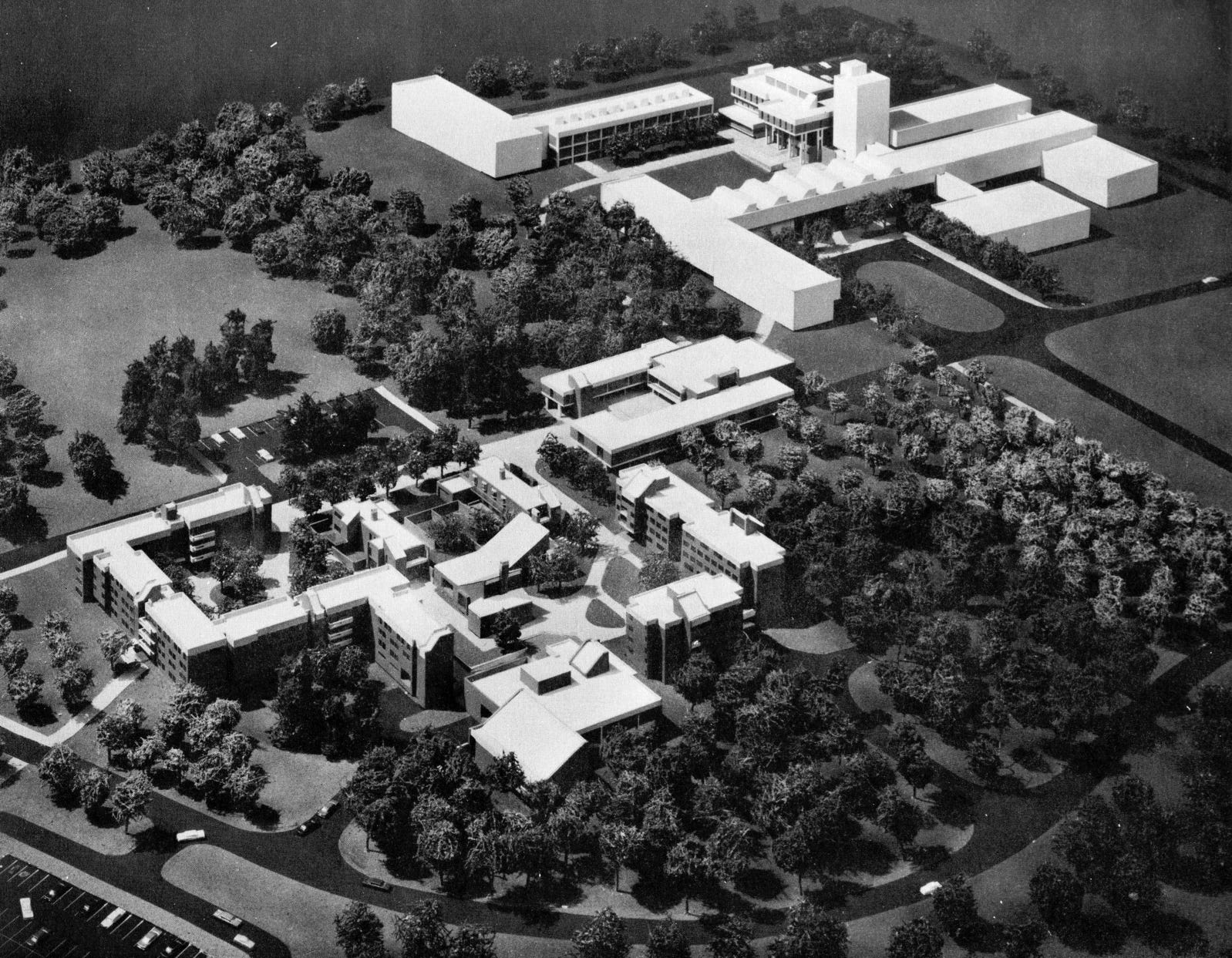
What Hampshire Was
I was a student at Hampshire College for four years, from 2009 to 2013. I went on to get my PhD at NYU, after which I went back and spent two years as a professor at Hampshire, teaching cognitive science from Fall 2022 to Spring 2024.
Hampshire was founded on the premise that the standard model of higher education is actively hostile to real learning. Grades, tests, required courses, and academic departments are more than just dead weight — they make things worse. So Hampshire threw them out.
Instead of letter grades, students at Hampshire receive written evaluations, sometimes a page or more. Grades can be gamed with last-minute cramming or strategic test-taking, but evaluations reflect whether you have actually learned the material, as judged by the person who taught it.
At a normal school you can get a B+ by showing up and being reasonably smart, and you can often get a good grade simply by avoiding attention. A Russian friend recently told me about her experience in university. “Students are focusing on points instead of gaining knowledge,” she said. “On our ‘team work’ guys pick the simplest topic, and I said, ‘let’s pick something challenging, this is too easy’. And they said, ‘well yeah, that’s the plan, to have A and do nothing’.”
Grades encourage this nonsense, but written evaluations make that strategy impossible. Faculty are likely to write, this student chose the simplest topic while everyone else in the class picked something challenging.
There are no quizzes or tests, so there’s no cramming and no pointless questions about “will this be on the exam”. Instead, students read primary sources and do projects to build up their skills. At most schools a senior thesis is exceptional, but at Hampshire, it is the minimum. Every student has to do a year-long senior thesis in order to graduate.
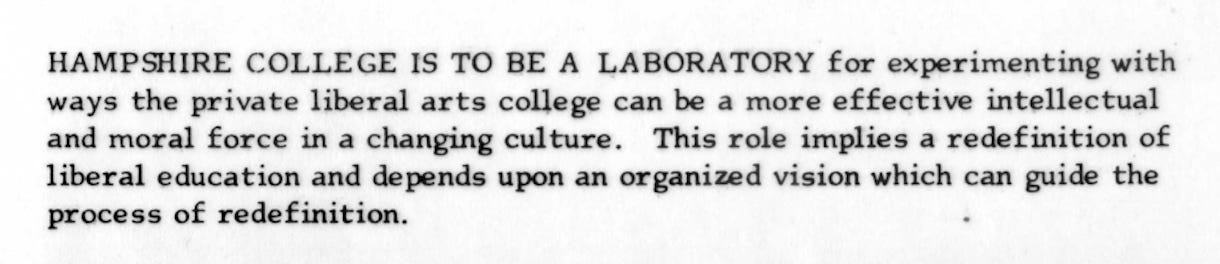
Hampshire has no majors, no departments, and no required courses. You can’t coast, and there is nowhere to hide. You can’t just take the courses as demanded by your department or major. Instead, your curriculum is a negotiation between you and your faculty advisor about what your education should actually contain. There is a lot of freedom, but it is structured freedom. Students who thrive at Hampshire are a specific type who find conventional academic structures frustrating because conventional coursework moves too slowly.
The hands-on learning that is promised at other schools is actually real at Hampshire. It is one of the few colleges on earth that still has a fully equipped machine shop that any undergraduate can walk in and use.

People think of Hampshire as artsy and activist-y, but the arts-and-film narrative the school leaned on is not remotely the full truth. You’ve probably heard of alumni like documentary filmmaker Ken Burns, or actor Liev Schreiber. I also think of alumni like Eugene Mirman, voice of Gene Belcher in Bob’s Burgers and author of the greatest commencement speech of all time.
But Hampshire also has a remarkable tradition of entrepreneurship. Per official metrics, one in four Hampshire graduates go on to start their own business or nonprofit. You probably recognize some of the founders from their companies, like Stonyfield Farm Yogurt (founder Gary Hirshberg) or Duolingo (founder Jose Fuentes). You may have encountered jackets from “superhuman streetwear” brand Volante Design, but you probably didn’t know that it was founded by two Hampshire alumni, David and Willow Volante, who met at Hampshire.
Hampshire’s history of producing astonishing STEM research opportunities has never gotten enough credit. Sure we have alumni like Academy Award-nominated singer-songwriter Elliott Smith. But we also produced alumni like space plasma physicist Cynthia Cattell, theoretical physicist and popular science author Lee Smolin, founding member of Ubuntu and Debian Benjamin Mako Hill, and AI researcher Gary Marcus. Since you’re reading this on Substack, there’s a good chance you’ve also heard of writer, neuroscientist, and Hampshire alum Erik Hoel, and his Substack The Intrinsic Perspective.
This is not a throwback to a brighter age: Hampshire continued producing amazing STEM graduates right up to this year. One of my former students was always coming to my office to show me her microscope work, despite the fact that it was much too advanced for me to understand. She was consistently at the top of the biology classes she was taking at Smith and UMass, and her senior thesis was applying microscopy techniques to examine alpha-crystallin B, a protein associated with Alzheimer’s disease. I know some of those words. This is a real Hampshire grad and you can hire her right now.
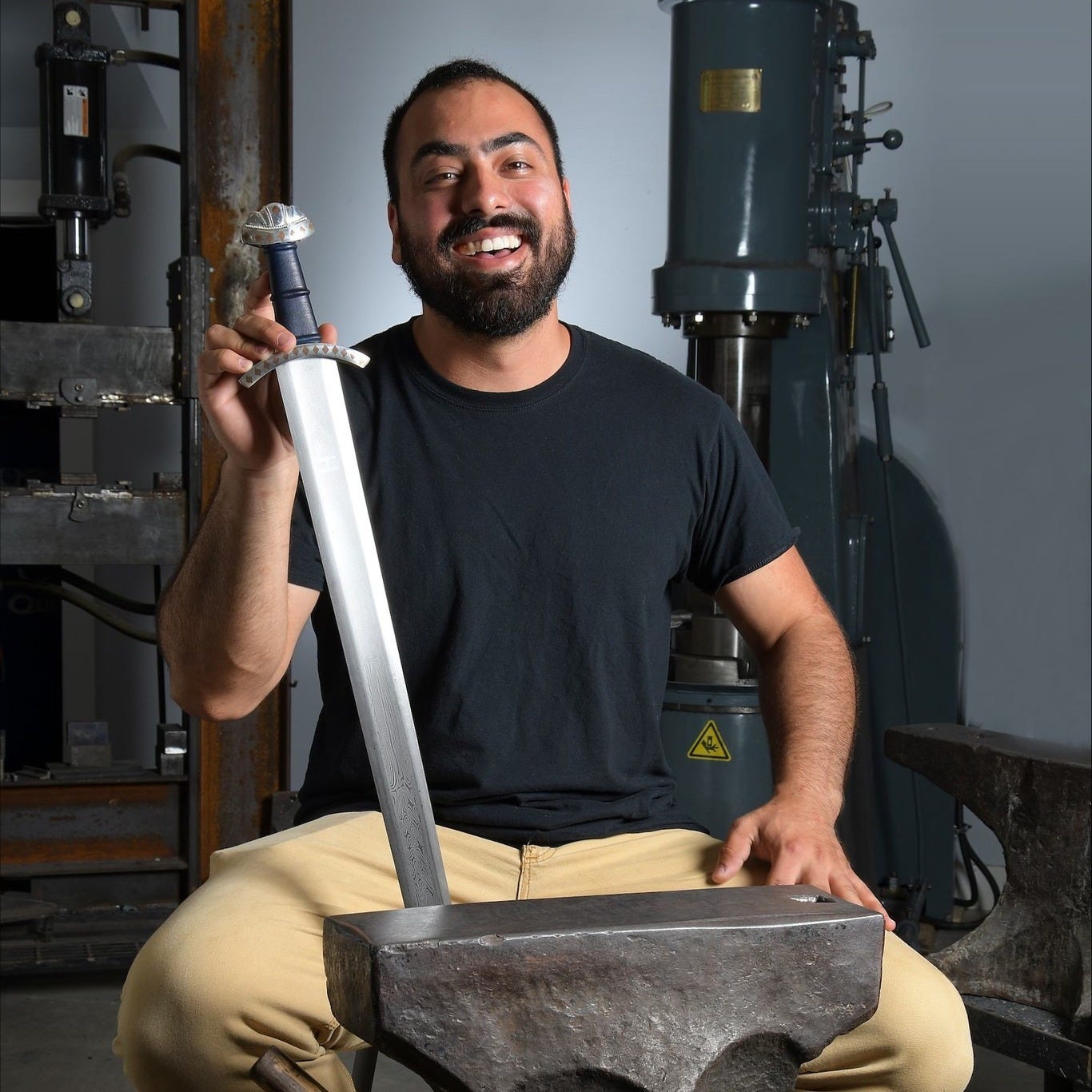
This isn’t to say that I look at how Hampshire has been run and would rather that “STEM-types should be in charge”. If hippyism is an excess of right-brain thinking, STEMlordism is an excess of left-brain thinking.1 Something like “renaissance humanism” is the more interesting synthesis, and you see a lot of that at Hampshire. Take me for example: I studied cognitive science, but I spent enough time in the shop that everyone thought I was studying blacksmithing.
“When I first came to Hampshire, I thought I was gonna do writing and sculpture,” reflects Nicole DelRosso, “but I wanted to take a neuroscience class, because in my high school I didn’t have access to interesting courses like that. I was just dying to know more about the brain.” She switched to studying neuroscience, and six years later she won a Fulbright scholarship.
Or take my friend Talia Adi: “I knew I wanted to study neuroscience,” she said in a recent interview, “but I had trained as a ballet dancer and wanted to have the flexibility to pursue a multidisciplinary education. … I was also able to continue dancing as part of the Five College Dance Program and even took a year off after my first year at Hampshire to move to New York and dance full time.” After graduating she worked at a lab at Yale, and is now on the cusp of finishing her M.D./Ph.D. program.
People love Hampshire despite its many flaws, and they give up ostensibly better opportunities to go there instead. I recently saw a good example in Christopher Benfey’s New York Review of Books piece A Clearing of the Ground, where he shares this story about the early days of the school:
Those who were there at the origin never forgot the heady excitement of the place. My older brother turned down a Yale scholarship to enter Hampshire’s second class in 1971, where he read Chaucer, built a pottery kiln, and took off after a year for a trip around the world before becoming a prominent molecular biologist.
Hampshire has had a high transfer rate, especially in the last decade, but there are also many students who transferred to Hampshire. These students had other options, but rejected that path to finish their studies at Hampshire instead.
One of my good friends at Hampshire started out as a Mount Holyoke student, but she kept coming to more and more Hampshire events, started taking Hampshire classes, and eventually decided to transfer. More recently, I advised a student who had started at Clark University, but found himself disappointed with the slow pace of his classes there. So he transferred to Hampshire, where no one would keep him from working as fast as he wanted.
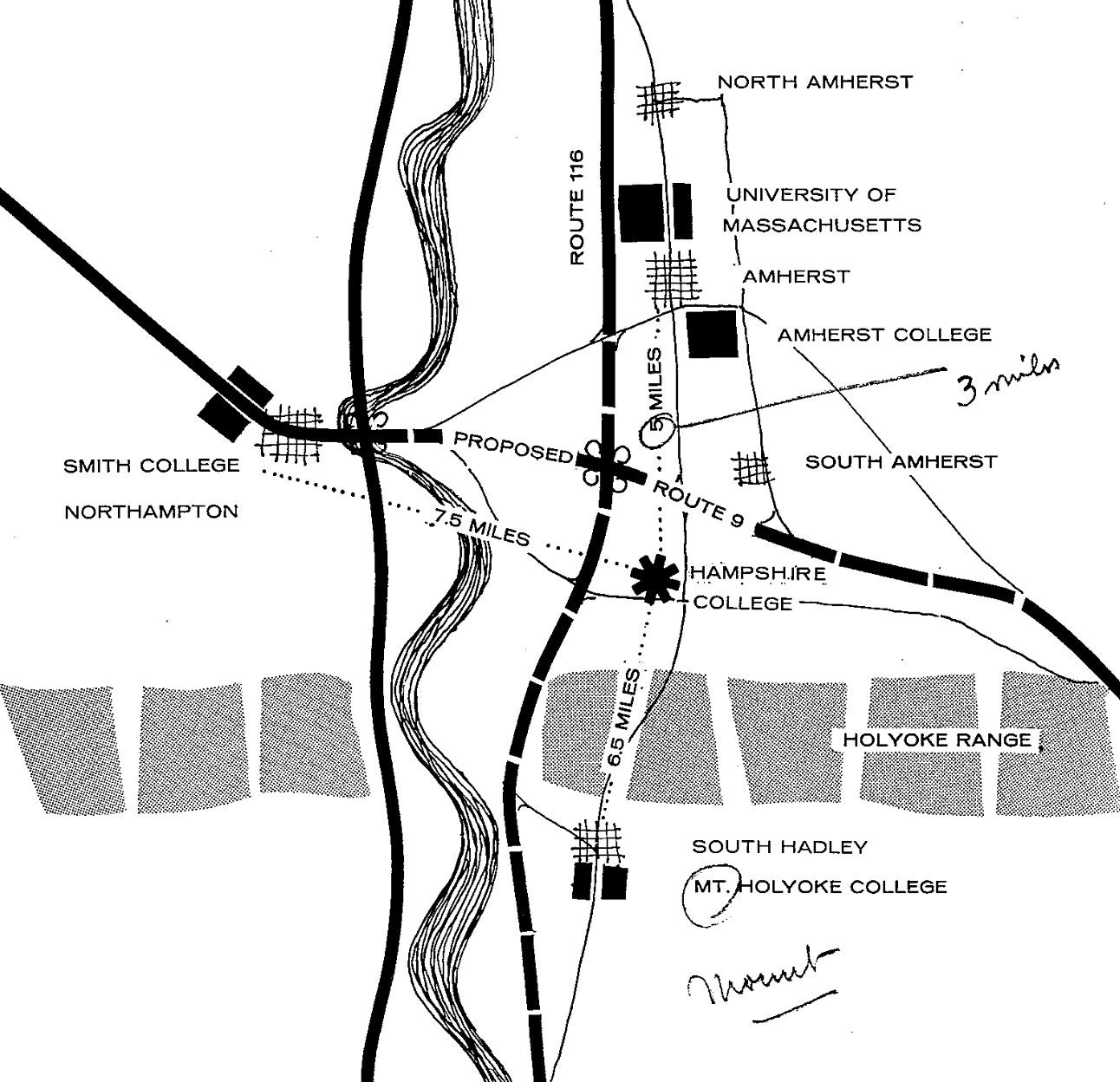
Finally, I should mention that Hampshire is part of the Five College Consortium, so students can take classes at Amherst, Smith, Mount Holyoke, and UMass. This means access to one of the richest academic ecosystems in the country, while still doing things none of those schools are ambitious enough to try.
Elite Human Capital
Back in 2005, Paul Graham wrote that undergraduates are undervalued. Not on average, because the average 20-year-old is not very capable, but in the spread:
The most productive young people will always be undervalued by large organizations, because the young have no performance to measure yet, and any error in guessing their ability will tend toward the mean. What’s an especially productive 22 year old to do?
His advice was to start a startup: go around employers entirely, start a company, let the market judge you directly.
I basically agree, but this advice only works for aspirations that fit neatly into the market. If you have a 20-year-old Darwin, you don’t want him trying to start a startup. You want him joining a community of scholars, finding mentors, and doing the slow work that compounds over a lifetime. You want him planting seeds that will take decades to bear fruit.
Even technologists and entrepreneurs are rarely ready to do this at 20. Meeting your co-founder at college and dropping out together is a classic for a reason, the college part still did something. Those who are 100% ready should probably just go start their startup and skip college entirely. But those who are 80% or 90% ready should have a place to go that takes them more seriously than the average school treats the average undergraduate.
This brings me to what Hampshire actually was at its best: a magnet for an unusual kind of student talent. My friend Adam Mastroianni, who went to Princeton and then to Oxford and then got his Ph.D. at Harvard where he was a resident advisor, certainly has seen a lot of talented students. But when he visited my class and talked to a handful of my students, he came away genuinely surprised.
“I pretty much had my pick of the most talented undergrads in psychology from across the country for years,” he told me, “and didn’t find people who were as interesting to talk to.” But what really struck him was their initiative. When given an opening, my students immediately asked how they could help, what they could learn, what they could build. “Is every Hampshire student this high agency,” he asked me, “or is it just the three that I talked to?”
“Yes they are really like that,” I said. “They are all like that.”
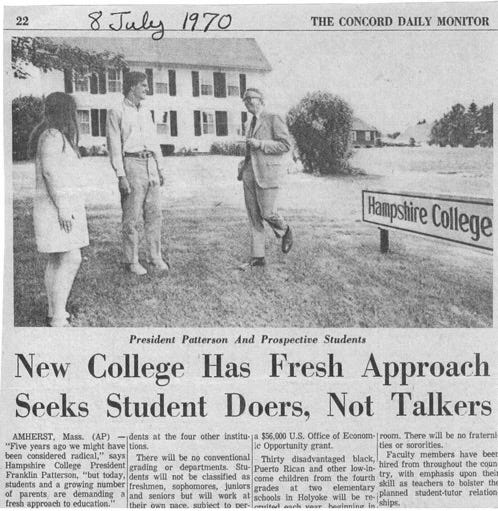
Paul Graham mentions that what surprises him most about undergraduates is how conservative they are. “Not politically, of course. I mean they don’t seem to want to take risks. This is a mistake, because the younger you are, the more risk you can take.”
This explains why Hampshire’s selection effect is so strong. Most college applicants are deeply risk-averse; they’re optimizing for credentials, safety, legibility. Hampshire is beautiful because the entire model filters that out. Choosing a school with no grades, no majors, and an uncertain future is about the riskiest move possible at 18. You’d have to be totally bold or wildly ambitious to take that choice. You’d have to not care about collecting credentials at all.
The students who end up at Hampshire demonstrate something important about themselves, just by showing up. Adam was surprised because he spent years working with student pools that were filtered for achievement, but Hampshire filters for something much more rare and hard to measure.
Why Higher Ed Needs Exactly This Right Now
Higher Ed in the US sucks right now, and its greatest weaknesses have historically been Hampshire’s greatest strengths. A revived Hampshire College, with intelligent leadership, could punch hugely above its weight.
Grade Inflation
Grade inflation has reached the point where the median grade at many elite universities is now an A, making transcripts nearly useless as signals of actual ability or effort. When everyone gets an A, the grade stops meaning anything.
Narrative evaluations, which Hampshire has been doing for 50 years, already solve this problem. Grades are hackable because they’re produced by a known algorithm, which the professor gives you in the syllabus on day one. Once you understand the rubric, you can optimize for getting the highest grade, instead of learning the most material or developing the deepest understanding. In fact, students who prioritize real learning or understanding get worse grades than their classmates who just focus on gaming the system.
Narrative evals can’t be hacked because there’s no rubric to game. You can still butter up the professor, but at least you can’t do it algorithmically. Unlike a letter grade, evaluations require a professor to describe what you did, so they convey real information. When they’re good, they are much stronger than an A. When I was a student, one of my evals said, “Ethan writes like a second-year grad student”. You can imagine how that looked when I was applying to grad school.
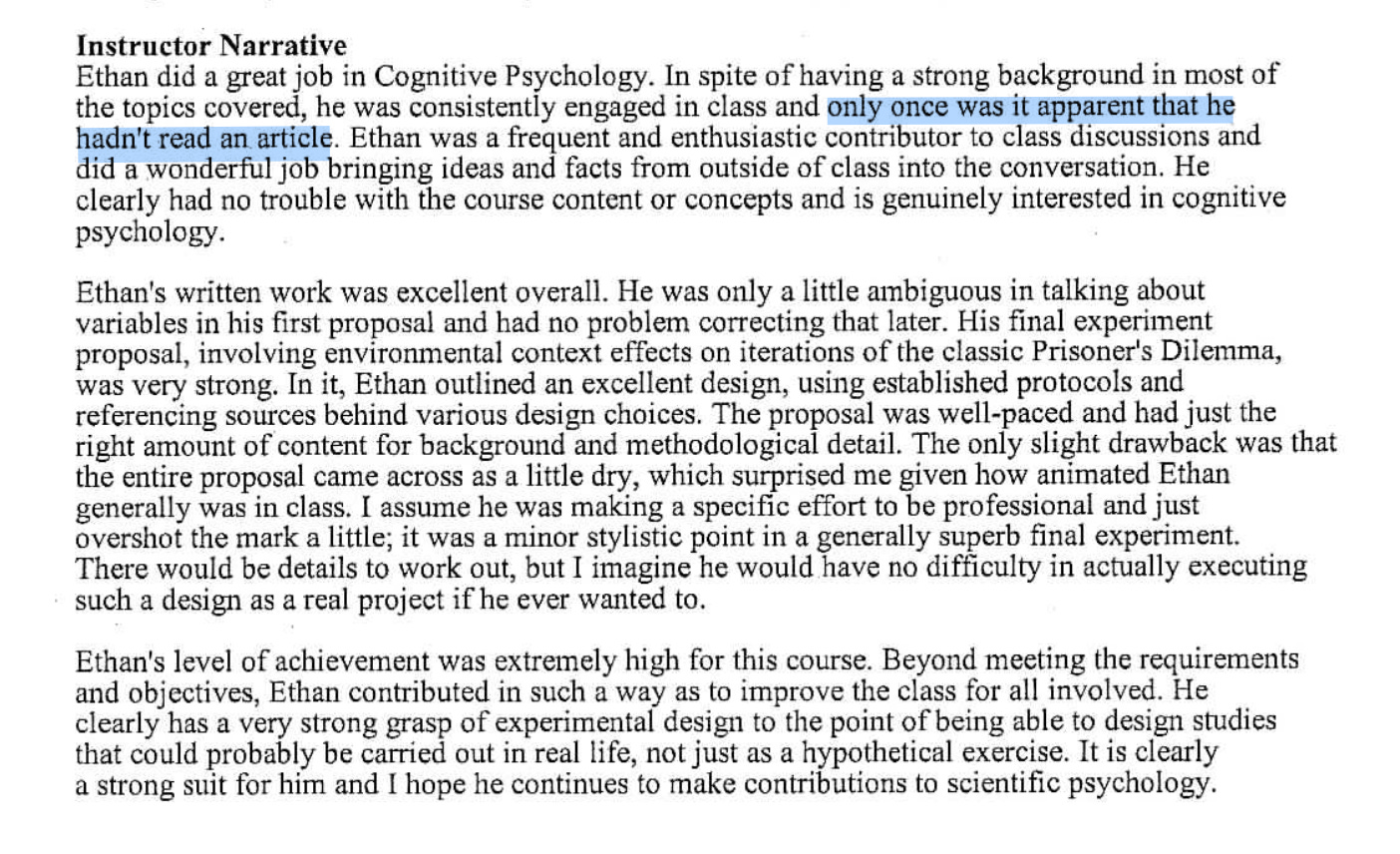
When they are bad, they are much worse than a D. I never got a “bad eval”, but in my third year when I took Cognitive Psychology, I skipped the readings on one single day of class, and Jeremiah “Jay” Trudeau called me out for it in my evaluation. Jay, I want you to know that I think about this comment to this very day. He also called my final experiment proposal “a little dry”. You’re killing me here man.
Project-based learning solves this even more neatly than evaluations do. If an evaluation conveys more information than a grade, the work itself conveys more information than the evaluation. A Hampshire education is valuable not for the degree per se, but for the body of work you created during your time with the school.
AI in Education
AI cheating is rampant in higher education, and worse, it’s surprisingly defensible. If you ask students why they use LLMs to cheat, they’ll tell you that they use AI as a weapon against tedium and busywork. It’s hard to blame them when they know that no one cares about their five-paragraph essays. The standard conversation around AI — “How do we catch students, how do we stop them?” — makes everyone paranoid and antagonistic.
Without grades and busywork, LLMs stop being such a threat, and you can completely sidestep the endless arguments about cheating. It puts you in the nice position of not having this faculty-student war. Using ChatGPT to do derivative, passable work makes a lot of sense when you are aiming at a rubric, which is why students at traditional schools do it all the time. It doesn’t make sense when you don’t have grades. Submit something mid, who cares. Your eval will say, this student’s writing was mid.
Hampshire doesn’t need to be an “anti-LLM police state”, nor does it need to be a handwavy “AI-first education”. It can just be what it has always been, a place that asks students what they’re passionate about and what difficult, ambitious things they want to make. That was a good idea in 1970, and it looks even better when every traditional institution is tearing itself apart over ChatGPT.
Practical and Intellectual Skills
Conventional education produces students who are helpless, both intellectually and in the physical world. My Irish exchange student once told me, “I love how you guys do classes with a lot of debate. Even when I started my bachelors back home it was more drilling of ‘knowledge’ and barely any room for debating or deep discussions.”
The practical side is no better. At NYU, I discovered that most students couldn’t identify a goose. As part of a lecture on categories, the professor would put a goose on screen and ask what it was, and students would say, “a duck.” I had NYU students who saw me eating carrots and were concerned for my health that I didn’t peel them first. These students weren’t stupid, but their education had kept them so far from the actual world that basic reality had become unfamiliar.
Before grad school I worked at Harvard for a few years. One of our RAs was a 4.0 Harvard senior, very talented kid. But at one point we learned that she couldn’t cut limes for drinks at her graduation party, because she didn’t know how to use a knife. Her parents never let her.
In contrast, Hampshire students make knives. Sometimes professionally, like Emiliano Carrillo, who you may have seen on season 3 of Forged in Fire. They can fix a power hammer, they can lay a bead, they can cut a lime. (Specialization is for insects.) They can even sell hot dogs out of the window of their first-floor dorm room. The senior thesis that every Hampshire student has to complete to graduate demands that you do something real, even if it sucks. Not write about something real. Do it.
Better Teaching Is Available
The higher education market is more distorted than most people realize. Schools hire professors based on prestige and arcane internal politics, not teaching ability, and application processes are stupidly onerous. The result is thousands of talented PhDs either unable to find work or trapped in grueling back-to-back one-year contracts. This is concerning, but also a tremendous opportunity. A school that was committed to great teaching and advising could have its pick of exceptional people.
For example, Dr. Bret C. Devereaux of the blog ACOUP, in his wonderful Academic Ranks Explained Or What On Earth Is an Adjunct?, says:
Most adjuncts in order to make ends meet have to stack multiple heavy course-loads due to the shamefully low pay they receive, and so while many adjuncts are dedicated teachers they are rarely able to give each class the time it needs. That is compounded by the fact that the short-term nature of adjuncts means they have little freedom in what they teach, since getting a new course ‘on the book’ takes time and is thus impossible for an adjunct with short-term appointments. I have been repeatedly asked by students when I would teach a course on Greek or Roman warfare and the answer is ‘never’ despite tremendous student demand because I am never in an appointment long enough to propose and get approval for the course to be on the catalog.
One of the things that the old Hampshire got right is that faculty were able to teach whatever they wanted. Bret would clearly do better, and his students would be better off for it, if he had the same freedom. Offering that freedom when recruiting faculty would sweeten the deal for them and improve things for the students, who would finally get the courses on Greek or Roman warfare that they so crave. There are thousands of adjuncts with proven track records like this who would be motivated to take a better deal; which is a low bar, since they are treated so poorly.
In short, you could approach whoever you wanted and offer them a very sweet package: You don’t have to apply to the job, we want YOU. Teach whatever you want within your discipline. We don’t care about your publishing or any of that other academic nonsense. Here’s a five-year contract, long enough to really develop your curriculum. As long as the college appears stable enough to last even a few years, many people would take that deal.
You could also hire some professors of practice, like universities used to. These are people who have been successful in a professional field who are brought in to teach, based on their real-world expertise rather than research credentials. A journalist, executive, or electrical engineer might teach as a professor of practice, either part-time or after retirement. They typically don’t have the normally required degree, like a PhD, and they’re not on the tenure track. Or you could hire people straight out of grad school, that traditional institutions are too cowardly to hire. But as always, a market inefficiency is an opportunity for those who are not irrational, and this time, it could be us.
Competition on Model
Almost every other college is interchangeable. The selective ones compete only on status, the non-selective ones compete only on price. There is basically no competition on model.
At every other college, all students are given basically the same experience. There’s some honors stuff, but everything has to be aimed at the lowest common denominator student. If you’re ready for graduate work sophomore year, Harvard and Yale are not really set up for you to do that.
Deep Springs (total enrollment: 26 undergrads) and Minerva (sophomores are in Tokyo, juniors are in Buenos Aires, seniors are in Taipei, faculty are all remote) seem to be the only thing close. And these are probably good comparisons. Both programs seem successful despite many reasons they should not be, probably because they offer an experience you can’t get anywhere else.
In 2024, Genomics PhD Ruxandra Teslo gained some recognition writing about higher education with her piece, The flight of the Weird Nerd from academia. Later she wrote an even more popular follow-up called The Weird Nerd comes with trade-offs, where she offers the following rule: “Any system that is not explicitly pro-Weird Nerd will turn anti-Weird Nerd pretty quickly.”
Hampshire was special because even though the people in charge didn’t always understand the mission, the school was structurally set up so that no one could stop weird nerds from prospering. “No one told you what classes to take, and as a result, none of you know math,” joked alum Eugene Mirman in his graduation speech roast. It’s funny because there’s some truth in it, but it is a joke. I know, I’ve taught statistics.
Double down on that model, and staff it with an administration that is pro-Weird Nerd, and you will see something amazing.
The fundamental problem with higher education? Students want to learn things and they want to do things, and the schools don’t seem to believe that. The “structural changes” that need to happen are simple: schools need to hire faculty who believe that students want to learn, and who have some sense of what students actually want to pursue.
If you read that and thought “quirky electives”, then your intuitions are also wrong. When I taught at Hampshire, the two largest classes at the entire school, so popular they were overenrolled every time, were my courses Introduction to Psychology and Negotiation.
The Vision
The motto of Hampshire College is Non Satis Scire: “to know is not enough”. When Hampshire works, it works because someone is living this motto. It’s not enough for a history student to know how a medieval suit of armor was built, they need to make one themselves. It’s not enough for an entrepreneurship student to know how to design a business model, they need to start their own food truck and staff it with other students.
The unofficial nickname of Hampshire College has long been “grad school for undergrads”, because of its insanely high grad school placement rate (an average 8.4 out of every 100 Hampshire alums earn research doctorates, placing Hampshire in the top 1.4% of colleges nationwide), because every student completes an essentially graduate-level year-long senior thesis, and because the average Hampshire class is the same format and level as a graduate seminar anywhere else. Seriously, Hampshire alumni are often surprised when they take their first Ph.D. seminar, because it’s identical to the classes they were taking at Hampshire, only slower and easier.
If you’re not familiar with grad school, you may think this means, “more classes, and harder”. But in fact, it’s an entirely different approach to education. In undergrad you are there to consume knowledge, which is why you read textbooks and take exams to demonstrate that you’ve absorbed what others discovered. In graduate school you are there to produce knowledge, which is why you read primary sources and conduct original research.
Most PhD programs have only two years of classes — for the rest of your time there, you’re a scholar doing scholarship. Hampshire’s model applies that same logic to undergraduates. Get up to speed as fast as possible, then start doing the real thing.

In recent years, the college has not taken these mottos seriously. Students are encouraged to complete projects, but these are mostly class projects, designed by faculty with little to no input from students. They write papers, but mostly class papers. Every student does a senior thesis, but not until their final year. Where is the school that is ready to take college students seriously as scholars and craftsmen?
Grad School for Undergrads
Therefore, my vision for the revived Hampshire College is a college where students do real scholarly and professional work.
In most colleges, you read textbooks about people who did real work. You don’t do real work, and you don’t even read the primary sources of the people who did the work. Maybe if you are lucky, you get to help with real work when you are in your last semester, as some kind of research assistant or something. I can’t believe we have let this become our dominant model of higher education.
Why would you want to spend all your time reading textbooks? Ugh! And memorizing them? Ugh! You want to get stuff that you don’t know, that anybody else doesn’t know, and try to figure out how to study it and how to think about it. (Hampshire founding faculty member Lynn Miller)
Whatever you study at Hampshire, you should be doing the real version of that thing. Hampshire biology students should be publishing their biology research. Hampshire journalism students should be starting papers, zines, and newsletters. Hampshire entrepreneurship students should be starting small businesses. It could hardly be more obvious, or more ambitious.
When I taught at Hampshire, I tried to do this with my classes. Instead of teaching a traditionally boring psych methods course, I taught Hampshire College Butchers the Psychology Classics, where we replicated several classic psychology studies with only two weeks of time allotted to complete each, and somehow succeeded. These replications were real contributions to the psychology literature, and some of them even had larger sample sizes than the originals.
Most people don’t believe that undergraduates can do this kind of work. They are wrong. Admittedly even I was unsure that my class, mostly not psych students and mostly with no research experience, could do a good job in only two weeks per study. But I was wrong too.
Hampshire advertised this “real-work-first” learning, but especially in recent years, it didn’t always deliver. It worked better for some sections of the student body, like art students, who always got to put on their own gallery show for their senior theses. In other subjects, students would often find themselves trapped in traditional coursework until they learned to use open-ended tools, like independent studies, to break free. Credit to Hampshire for having those tools at all; but in a revived Hampshire, real work should not be something students have to fight for the chance to do. It should be the default.
If you read the New York Times article about the purported end of the college, you’ll see a quote from Hampshire alum and filmmaker Ken Burns, who said that Hampshire offered “sort of medieval guild-like tutors and apprenticeships.”
This is also something we could enhance. Senior students should apprentice to faculty, beginner students should apprentice to the more senior. Again, Hampshire always did this a little, but it mostly did it on a small scale and often did it poorly. The founding faculty did it, but they are now all gone; no wonder Hampshire faded.
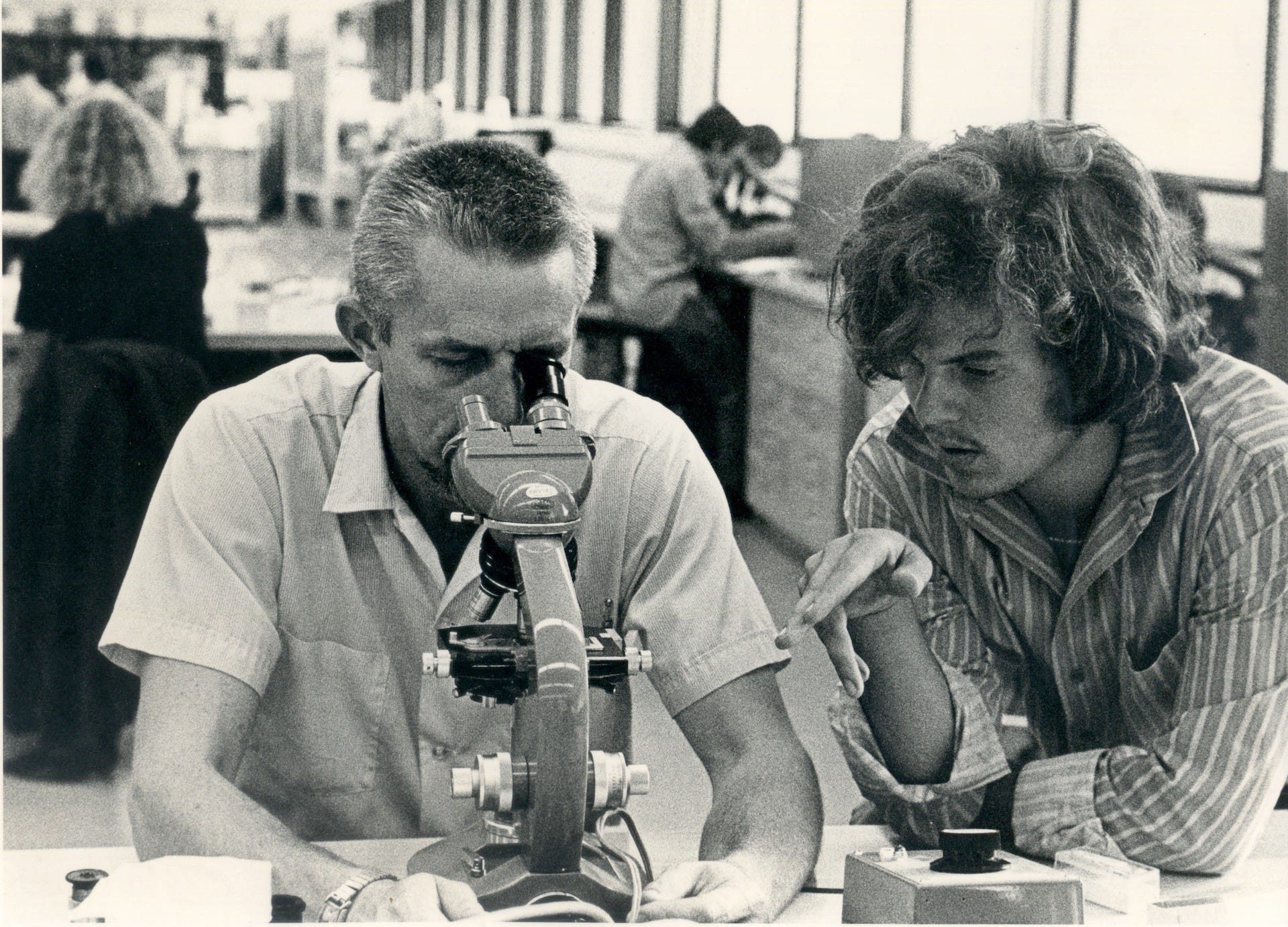
If you read this piece about founding faculty Lynn Miller (which you should, it’s amazing), you’ll see how Lynn treated his students as apprentices. See how he describes Jan Term:
We used to have a January term, three weeks long and the perfect opportunity for a lab course. In the first week our students would learn how to use the tools . . . pipettes, centrifuges . . . and how to run gels and handle themselves in a laboratory. At the end of that week, the instructors — I’d have several advanced students as instructors — would talk about their own projects, so students could then switch to working on a project that looked interesting to them. In three weeks we turned out polished, beginning molecular biologists. They could walk into a molecular biology lab anywhere in the country and be comfortable and do good work, right from the beginning. We got wonderful letters back from the faculty they were working with. They said, “Ah, you trained these kids well!” Because they knew how to handle themselves in the laboratory.

Every year there are a few hundred 18-year-olds who are ready to do graduate-level work in their field, and what are they supposed to do? Right now, they have to suffer through four years of undergrad before they are supported in doing real work. One of the only workarounds was for them to go to Hampshire College, where they could start doing graduate-level work without being bothered. The college should be retooled for this specifically.
If you hate credentialism, this is the model for you. Hampshire alums kick ass because every single one of them leaves the college with more than a piece of paper and letter grades that may or may not mean what they say. They all have in hand their senior thesis, an example of what they can do when given a full year to work on a project of their own choosing, which is more impressive (or more damning!) than any GPA. This is why they find it so easy to get into graduate programs, and this is why it would be a shame to let this model vanish from the earth.
Imagine an admissions department built around these principles. Dear talented high schooler. We noticed your original work in your subject area. Very impressive. If you go to most colleges they’ll make you take a bunch of survey courses on subject matter you’ve already mastered, and you will be so bored that your eyes will roll all the way up into the back of your head. Did you ever think about coming to Hampshire, where you could take graduate-level courses in your first year and continue your original work without being bothered?
More Online
Speaking of market inefficiencies, I’m kind of an internet maximalist. The internet is powerful and, in many cases, good. Like, there’s a reason that you’re reading this on a blog. My vision for Hampshire would be extremely online, with a special focus on learning how to share and market your work.
I don’t mean that Hampshire would become a school for influencers. But the internet is more than the future — it is the present, and most of higher education seems unaware of that fact. Past your first or second year, your academic work shouldn’t be produced just for your teachers, your classmates, or even your peers. It should be produced for the world, and the way to share your work with the world is to put it on the internet where people can find it. No matter how wise or educated you become, you can’t fulfill your ambitions alone. Writing about your ideas online is part of how you find your future collaborators, the people you need.
Being very online and publishing your work should be part of the new academic culture. Hampshire could have cultural dominance of the “young people doing real work” brand, which would attract all kinds of new students and new opportunities. If you’re doing projects that translate well to video, you should be putting them on YouTube. If you’re producing interesting writing or analysis, you should have a blog, or ten blogs. Bandcamp, Twitch, Steam, Substack, whatever it is. You should ship it, and learn to ship it well, because shipping your work is a skill.
Similarly, many faculty hiring decisions can be sourced from the internet. I plan to approach the chemistry YouTuber Explosions&Fire (he has an actual PhD) to see if he will be the chair of our new chemistry department.
There are a lot of other changes I would make, like a real student government with powers and responsibilities, and student involvement in the running of the college, like they did at Goddard College (see this Teen Vogue piece for more).
We had some of this when I was a student, though it was gone by 2022. We had student EMTs, and when I was sent to the hospital after my freak blacksmithing accident (blacksmithing is normally very safe), a student EMT was first on the scene. We had an IT department with student IT workers, which a previous administration confusingly closed, despite the fact that working in the student IT department led several of my close friends to get high-paying IT jobs right after graduation. I would revive all of these programs.
I could tell you how we should offer a 5-year BA/MA program — other colleges already offer these, and everyone at Hampshire already does a senior thesis, so why not make the senior thesis two years long and have the tuition go to Hampshire instead of some lesser MA program? But I won’t bore you with the details now.
What Went Wrong
One thing that can get lost in the stories of crisis is that the model was working. Between Fall 2022 and Fall 2024, enrollment grew 68%. Students were finding Hampshire, choosing Hampshire, and staying at Hampshire. I taught dozens of those students. The demand was there. It was going so well that in early 2023, they sent around a “Survey on Ways to Address the Increase in Student Numbers” to all the faculty.
Then in 2024, the administration slashed the admissions department, cutting one third of admissions staff. Budget cuts are sometimes necessary and never easy, but you don’t cut the department that’s producing some of your only good news while the school is fighting for its life. This is just eating your seedcorn. By late 2025, enrollment was back down to 750 students from a high of 833, and at the time of the announcement of the closing, the college was down to 625 students.
This was easy to see coming, which makes the decision all the more confusing. Admissions experts saw this choice and commented, “Without the admission office, there are no students. Without students, there is no revenue. Without revenue, there is no college.” Sure enough, cutting admissions was followed by reduced enrollment and a rapid slide towards collapse.
Some people want to make this a financial mismanagement story, but the truth is that the college missed its enrollment target this year by nearly half. The school is perfectly sustainable at an enrollment of 1000 students, which was the enrollment in 2013 when I graduated. Any financial problems come from falling tuition, which is all downstream from cutting the admissions department, weakening the academic program, and letting the student experience deteriorate.
Faculty are the lifeblood of an educational institution, but Hampshire kept making terrible faculty hiring decisions. Over and over again Hampshire would find good faculty, hire them, then cut them. A good professor can make the difference between a student dropping out and staying, especially at Hampshire, where students work so closely with advisors. But as a student at Hampshire, you could never tell if your favorite professor would be there next semester. Some of my friends had four different advisors over their four years at Hampshire. Faculty who taught courses that were massively popular with the students would often discover without warning that their contracts weren’t being renewed.
For years, students would show up at the college because they heard that it had a great game design program, only to discover that the school could not hold on to a single game design professor. Students heard about the great entrepreneurs among Hampshire alums and assumed we had the faculty to support that tradition. “I was under the impression it was an acceptable school for business majors,” one student told me while transferring away, “but it definitely is not.”
Faculty who could leave usually did, especially when the school nearly closed in 2019. Great professors found new jobs elsewhere. Teaching and advising quality suffered for these losses. Students came to Hampshire expecting a project-based model that would work with their unusual sleep disorder or chronic health issue, only to find themselves in classes with professors who would threaten to fail them for missing class during a two-week hospital stay.
Governance Model
My friends who have read drafts of this piece all ask me some version of the same thing: if you brought Hampshire back, how would you organize the new version of the school, and how would you make sure the same thing doesn’t happen again?
But as serious as it might make me look to have a “governance and operating model” appendix stapled to this blog post, I just don’t believe that having 7 board members instead of 9 board members will make a material difference, either in terms of fundraising or in terms of long-term success.
It’s worth having a theory of what went wrong, because without one it’s hard to understand how things went from working to not working, and even harder to know what would stop it from happening again. In many institutional failures, there’s a story that makes sense. Tough decisions under uncertainty, reasonable people who turned out to be wrong. Everybody thinks they are acting reasonably, so what did they think they were doing?
But the truth is that sometimes people just make bad decisions. And as best as I can tell, that is what happened at Hampshire.
Hampshire consistently had a balanced budget before 2019. Looking at Hampshire’s 990s, 2013 net tuition was $36.3M, or ~$51.5M adjusted for inflation. In fact, Hampshire had surpluses from 2013-2016.
Then in 2018 the board hired Mim Nelson as president, who pursued a secret merger with UMass, keeping the board and community almost entirely in the dark about what she was doing, until her surprise announcement in early 2019 that Hampshire would stop accepting new students while seeking a “strategic partner.” This led to a collapse in enrollment. Students who were already at Hampshire transferred out in droves, and tuition revenue disappeared with them.

If you went back to 2016 and tried to save the college, the advice would be pretty basic: don’t hire Mim in 2018. If that somehow happened anyway, at least don’t send what one faculty member described as an “utterly bizarre letter” to the 77 already-accepted students warning them that by fall the college might have no dining hall, no dorms, few faculty, and none of the services one could usually expect from a liberal arts college. Because as that same faculty member put it, the letter “said to us that not only was the college discouraging an entering class, but, having seen that letter, it seemed to be a spur for all the rest of the students to transfer, get out, as quickly as they possibly could, absolutely eliminating, or virtually eliminating, our revenue base.”
You can infer a lot about the board’s judgment from this one letter. The good news is that the president, the board chair, the vice chair, and “several other trustees” resigned, so the board since 2019 has not been the same board that made these decisions. But the college has made many confusing decisions since.
The school could simply not have sent such an apocalyptic letter, just like they could have chosen to not eliminate the IT department in 2023, or not cut ⅓ of the admissions department in 2024. Maybe these ideas made sense in some context, but if so you would have to read pretty hard between the lines, because the college’s justifications for such decisions don’t hold up to scrutiny.
I do think some structural things should change. Having faculty be in charge of faculty hiring decisions seems like it caused a lot of harm last time. When faculty have total choice over their membership, the school eventually comes to serve the needs of the faculty over the needs of the students, which leads to collapse. I wouldn’t give students total control of faculty hiring decisions, but you would need a more open process.
But writing out all those details now is like picking the paint colors for the new buildings we’ll name in our top donor’s honor. If there are funders who are interested, I would need to hash those details out with them, so why write the bylaws before I know who my business partners will be? I believe the vision matters the most, because the vision will attract (or repel) future students, staff, and faculty, and good people are more important than anything else.
The Runway
The bottleneck on this idea is simple: it would require a lot of money. By my estimate, around $175 million (for details, see the appendix).
We would need to secure the campus. We would need a couple of years of runway to keep things going until tuition stabilized. We would need additional funds to recruit and retain new faculty, more funds for accreditation and regulatory compliance. And ideally we would need some kind of endowment so that this kind of thing doesn’t happen again in the future.
We would probably keep the institutional identity, because a completely new institution wouldn’t be able to simply inherit Hampshire’s accreditation, and NECHE regional accreditation for a new college would take around five to seven years. Petitioning NECHE for a teach-out-and-continue arrangement rather than a full new-institution review would make a lot more sense.
You would need serious faculty recruitment to build the new, stronger teaching program, and you would need new administrators. The staff are amazing, and most of them could be retained.
Some people might be skeptical that it’s possible to raise the needed funds, since Hampshire has been trying to raise money for years now and failing. My answer is simple: Hampshire as an institution has been pretty dysfunctional. It’s no surprise that they had a hard time raising money. But a return to Hampshire’s original model of education, under competent leadership, might be able to raise the funds that the current institution could not.
All this is difficult but not impossible. Donors give billions of dollars in donations to higher education every year. Traditionally this money has gone to schools like the Ivy League, but with grade inflation rampant even at places like Harvard, donors who care about real education might like somewhere more ambitious to send their donations. It’s just crazy enough to work.
A single transformational donor — Somewhere there is a billionaire for whom Hampshire is an obvious bet. They’ve probably already funded a school, or a fellowship, or a learning program, because they believe from their own experience that conventional education takes the ambitious young people most capable of doing something original and redirects their energy towards getting very good at gaming tests.
In Hampshire they will find a fifty-year proof of concept, a model that when poorly funded and totally mismanaged has still produced scientists, entrepreneurs, artists, and thinkers across every field, an alumni base that testifies to its impact, and a price tag (a $200-300 million endowment) that is, for the right donor, an entirely tractable problem.
A coalition of tech/creative philanthropists — The Hampshire model appeals strongly to people who distrust credentialing, and few groups feel that as much as the founders, engineers, and investors who built the tech industry. The people most likely to feel the Hampshire model in their bones are the ones who succeeded despite conventional credentialing or succeeded outside it entirely. I’m talking college dropouts, self-taught programmers, and people who got their first job because of something they built rather than a degree they held.
For them, Hampshire is a vindication of their view on how learning and doing actually works. Traditional school actively trains you to optimize for formal systems and to please gatekeepers. It trains students to focus on grades rather than mastery, producing people who are good at paperwork and mediocre at everything else.
An existing institution — I don’t want to see Hampshire sold to UMass. But Hampshire is a member of the Five Colleges, and shouldn’t be shy of asking for help.
Amherst, Smith, Mount Holyoke, and UMass all have institutional reasons to want Hampshire to survive. Hampshire’s edge is part of what makes the consortium interesting to ambitious students who are choosing between the Pioneer Valley and, say, the competing schools in Boston. If Hampshire closes, many of those students leave the valley entirely. The consortium loses the particular kind of cross-disciplinary, high-agency student that Hampshire attracts, the kind of student who enriches classes at the other four schools too.
A collective loan guarantee of $10–20M from UMass, Amherst, Smith, and Mount Holyoke, in exchange for governance representation, protects something none of them could replicate on their own, and is an extraordinarily good deal.

Bequests — Hampshire’s oldest alumni are only now in their early 70s, and bequests have been few compared to what its older peer institutions receive. If we couldn’t quite make it to $175 million right away, we could supplement with charitable bequest pledges, where donors commit to leaving money to the institution in their wills.
This shows up on the books as a “gift expectancy” rather than cash, and they are revocable, so lenders and accreditors won’t treat them as assets. Donors can always change their wills. You can’t use them to satisfy requirements from NECHE, but you can use a portfolio of bequest commitments as evidence of long-term community support, to secure more favorable terms from donors and lenders on operations.
This is surprisingly achievable. A sum of $175M is a large but not impossibly large capital campaign. People raise this kind of money for higher education all the time some of the time. The cause is right, so with the right donors, in the right moment, it could happen.
Hampshire is a superior model of higher education. At its worst, underfunded, mismanaged, making administrative decisions that defy explanation, Hampshire produced scientists, entrepreneurs, and thinkers that rival any conventional university. Its failure was a recoverable own-goal rather than a structural inevitability, and because of AI and credentialism, the model is more relevant now than it was at founding.
This is a once-in-a-generation acquisition opportunity, and the window created by the bond deadline makes this moment unique. I won’t pretend I’m the obvious person to run the revival of a $175 million institution. But I believe in the mission, I’ve spent a career here as student and teacher, and I’m the person making this case. I’m ready to make it happen.
I almost wrote Hampshire a eulogy. But I like this kind of eulogy better.
If this resonates and you have the capacity to act on it, my email is <ethanludwinpeery@gmail.com>. Hampshire’s tender deadline is September 2026, and the window is narrow.
Appendix: One Hundred Seventy-Five Million US American Dollars
The Campus
Hampshire owns roughly 800 acres in South Amherst, with academic buildings, two dorm halls, three residential complexes, a farm, and a large solar array. According to its fiscal 2025 audit, the college’s total net assets stood at $37.9 million, with an operating deficit of $3.7 million.
This is not a bankruptcy. The board of trustees voted to permanently close Hampshire College following the fall 2026 semester in a voluntary wind-down, not a court-supervised liquidation. That distinction matters enormously, because the board retains control of the asset disposition process, which means they can negotiate directly with a prospective buyer rather than having a bankruptcy trustee run a fire sale auction.
Hampshire’s land in Amherst is simultaneously very large, partially constrained by wetlands and zoning, and encumbered by the bond debt and the bondholder’s mortgage lien. A naive estimate of campus value would start with the following. Rural/semi-rural land in the Pioneer Valley runs roughly $15,000–$40,000 per acre depending on use and zoning. Hampshire has roughly 40 buildings totaling perhaps 500,000+ square feet; at $200–300/sqft replacement value, buildings alone could represent $100–150 million in replacement cost, though market value for a specialized campus is far lower.
Comparable distressed college campus sales in recent years (e.g. Burlington College in Vermont, College of Saint Rose in Albany) have typically closed in the range of $20–60 million for the whole institution. On that basis you might estimate $35M as a midpoint acquisition price. Add $25M to retire the bond debt, and a naive buyer is looking at roughly $60M just to get started.
But the actual number is probably lower.
Remember, the encumbrance on the campus is the bond debt. According to recent reporting, Hampshire holds approximately $25 million in bond debt, with lenders holding a mortgage on campus properties as collateral. Retiring that debt is the primary obligation any buyer must satisfy.
More urgently, Hampshire faces a September 2026 tender date, at which point it would be obligated to buy its bonds back. That is a hard deadline that creates real time pressure, and real leverage for a buyer willing to move quickly. The trustees aren’t looking to turn a profit, they only need to satisfy the bondholders and wind up cleanly. An educational buyer who assumes the bond debt and moves before September has a strong negotiating position.
The practical implication is that acquisition cost may be considerably lower than a standard distressed campus sale would suggest. A buyer willing to assume the ~$25M in bond debt, move before the September tender date, and make a credible case for continuing Hampshire’s educational mission could potentially acquire the campus for close to the bond value alone. Call it $25-30M for the campus rather than $60M, a meaningful difference in the overall capital requirement.
The Runway
So, with ~$25 million to assume the bond debt and acquire the campus from a board that has no reason to extract maximum value, with a comfortable margin we’re looking at roughly $30 million to start.
Add $30 million for two years of operating runway while enrollment builds. In year one, a relaunched Hampshire might enroll 250 students, a conservative target given that Hampshire enrolled 306 students in fall 2023 and 275 in fall 2022, both under a struggling institution with a damaged reputation and limited resources. At a sticker price of roughly $60,000 and a discount rate of around 50-60%, expect net tuition revenue of somewhere between $6M and $7.5M. The founding endowment (more on this below) contributes another $5 million per year at a 5% draw rate, for total annual revenue of roughly $11-12.5 million. Against operating expenses of around $25 million at a lean restart (most costs are fixed regardless of enrollment size) that’s an annual gap of about $12.5-14 million. Two years of that bridge with a margin for error is $30 million.
Add $5 million for faculty recruitment and retention, $3 million for accreditation and regulatory compliance, and we’re at $68 million.
Finally, add a founding endowment of $100 million to make sure this kind of nonsense never happens again. At 5% draw rate, $100 million generates $5M/year, supporting the operating budget and providing a buffer.
This conservative estimate puts us at $168 million. Round up to $175 million to be careful and account for various margins, including the possibility that the bond negotiation goes less favorably than hoped or that the September tender deadline creates cost pressure. If we want to be really conservative, call it $200 million. But the honest number, if acquisition goes well, is closer to $175M, and possibly lower. Give or take, this is all it would take to do it right.
The window here is narrow. The September 2026 tender date is the moment at which the bond situation becomes significantly more complicated and expensive. The discussion about selling the campus is already underway. A buyer who moves soon is in a fundamentally stronger position than one who waits.
In the colloquial sense. Please forgive me, Hampshire neuroscience students.
Thank you for such a thoughtful analysis of what made Hampshire what it is. The “grad school for undergrads” is what attracted me to the school in the mid 80s. And it is still a rare and much needed educational paradigm.
after what happened with goddard, (& less dramatic changes in other alternaschools across the country) i really hope someone comes in & makes your vision possible.