

“Being defeated in battle does not happen on the day the drums give the order to advance; one’s daily conduct has been without discipline for a long time.”
— Huainanzi
Hampshire College is the greatest model of higher education ever invented. It’s a model that produces a higher proportion of research doctorates than almost any other school in the nation, but the way the model is described makes it sound like a college for slackers. “No grades, no tests, no majors” conjures up images of free love and ultimate frisbee.
Hampshire markets itself all wrong. The way alumni, students, faculty, and the college itself talk about the college reinforces the slacker perspective. Instead of naming what the college is good at, marketing materials are vague, defensive and apologetic.
I especially hate how apologetic the messaging from alumni has been, and I hate how apologetic I was in the early drafts of my recent appeal to revive the school. It was so hard to get myself away from this perspective, and say what was great about Hampshire with my whole chest. But in writing that piece I had a spiritual revelation, and here it is: Hampshire is the greatest model of higher education ever invented, and I don’t care who knows it. *Let me tell you why.*
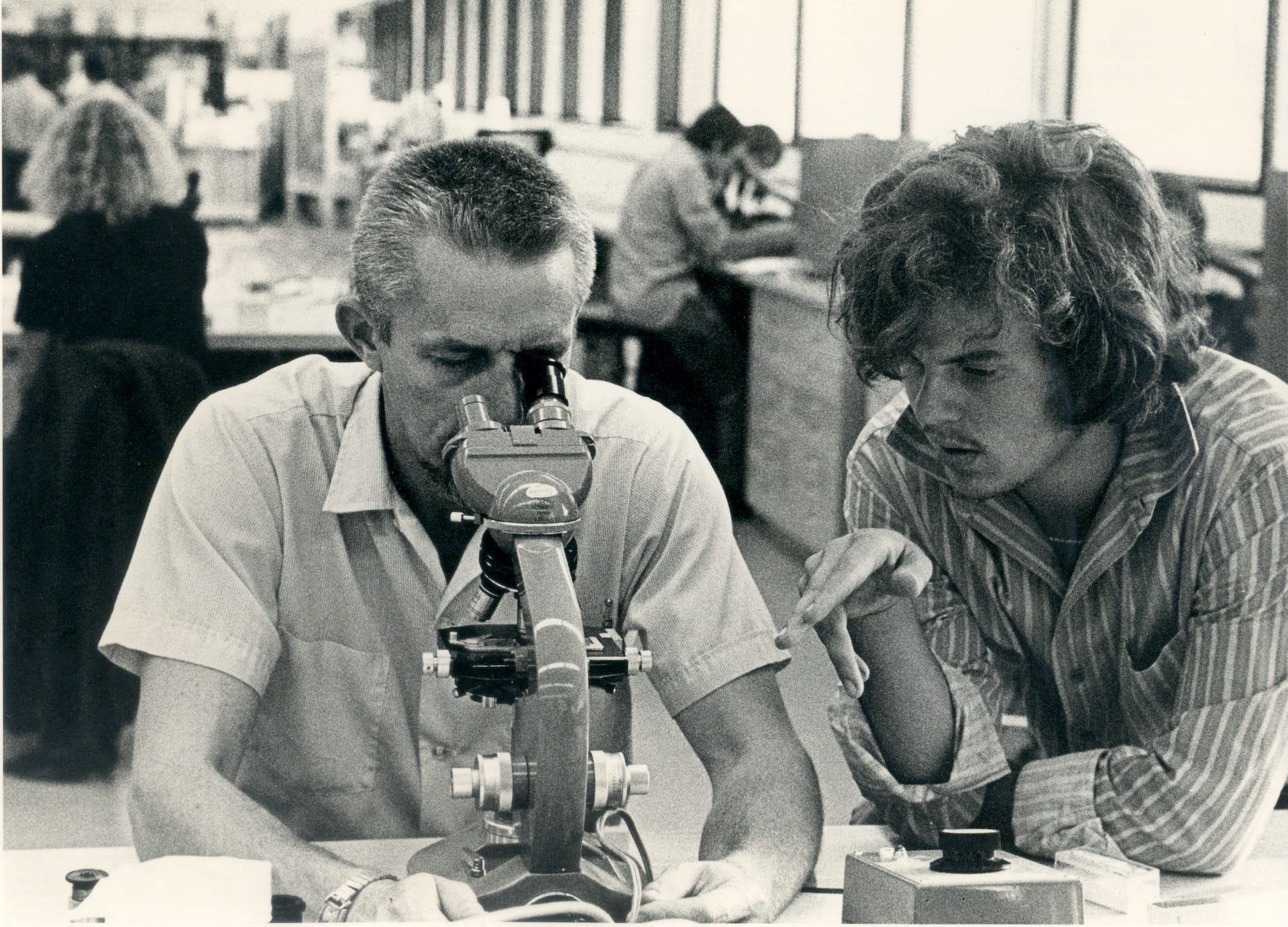
When I went to Hampshire, I knew I wanted something better than high school, but I didn’t know what normal college was like. I thought the value proposition of Hampshire was the fact that it had no grades and no tests. But this was only because I had no idea how bad higher education had become.
At a superficial level, Hampshire looks a lot like other schools. You still pick courses out of a course catalog. You go to classrooms and you complete assignments. You even fill out worksheets and do homework. It’s easy to think that Hampshire offers the same kind of higher education you can get anywhere, minus its quirks. But you would be wrong.
It took me years of seeing other schools to understand how much worse off the average college student really is. At most other schools, you are stuck in lectures with hundreds of other students. Your underpaid adjunct teacher leads you through a lecture that you don’t understand, and later a PhD student leads you through a “section”, where they go over the same slides the teacher used, and try to explain what they mean. You have to take years of gen ed courses and prerequisites, even if you’re ready for harder stuff. You may have an “advisor”, but they’re probably not faculty and they don’t advise you in any meaningful way.
Hampshire’s model is much more rigorous and ambitious than the average college, and certainly more rigorous and ambitious than the other colleges I have seen up close, namely NYU, University of Arizona, and Harvard. There are probably individual schools and departments out there that are better, but I think they are only better because they’re run by excellent people. I don’t think there’s a better model.
The Hampshire model is genuinely powerful, and Hampshire itself has been underselling it badly. Here’s what the data actually show:
Hampshire ranks in the top 40 nationally for PhD attainment, an average of 8.68 of every 100 alumni go on to earn a doctoral degree
Two-thirds of graduates earn an advanced degree within ten years of commencement.
One in five Hampshire science students who complete their thesis are invited to present at a peer-reviewed conference.
Five percent of Hampshire science students are lead authors on published, peer-reviewed journal articles as undergraduates.
A quarter of Hampshire alumni start their own business or organization, placing Hampshire #6 on Forbes’ 2015 list of most entrepreneurial colleges.
Despite these achievements, that’s not the cultural identity Hampshire has established. Prospective students, parents, funders, and journalists don’t know about any of these metrics. It’s not how the students, staff, or faculty think of the school, it’s not what they convey when they speak about the school to others, and that’s the problem.
Crash Course in Marketing
Even Hampshire can’t explain why Hampshire is great. We know that Hampshire is amazing, but when we try to describe it to outsiders, we tend to use clichés and platitudes. So outsiders assume that we are just nostalgic for the four years of our lives where we could get away with not wearing shoes.1
“Grad school for undergrads” is a great motto, as is Non Satis Scire, “to know is not enough”. But in addition to a good motto, we need to be able to describe the model in a way that captures what the school is really offering. Saying “no grades, no tests, no majors” is technically accurate, but it makes the school sound like a vacation, not the rigorous education that it really is.
Let’s do a case study of the marketing copy from one flyer, though feel free to check out the admissions page to confirm that it’s representative.
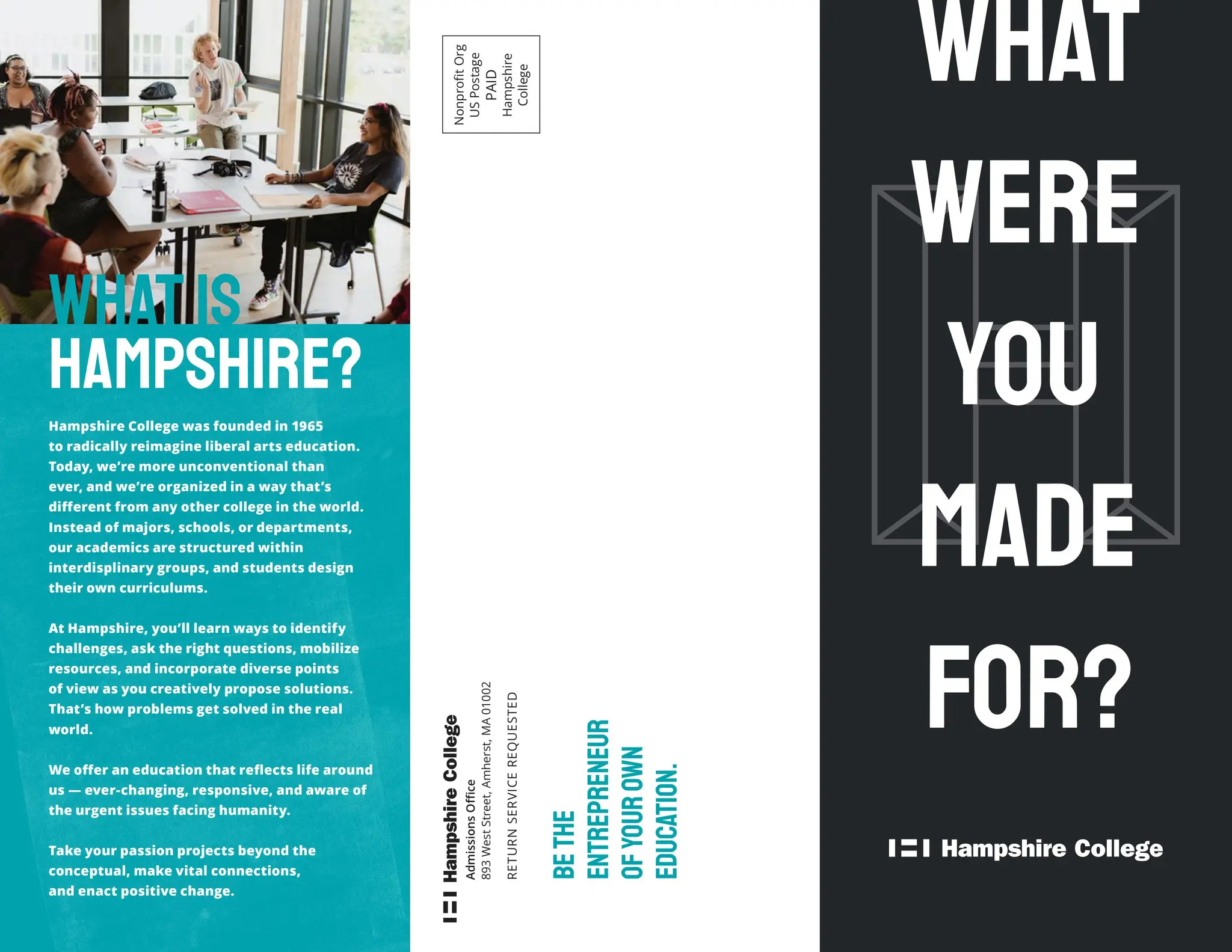
Here’s the copy as a paragraph, let’s take a closer look:
Hampshire College was founded in 1965 to radically reimagine liberal arts education. Today, we’re more unconventional than ever, and we’re organized in a way that’s different from any other college in the world. Instead of majors, schools, or departments, our academics are structured within interdisplinary [sic] groups, and students design their own curriculums. At Hampshire, you’ll learn ways to identify challenges, ask the right questions, mobilize resources, and incorporate diverse points of view as you creatively propose solutions. That’s how problems get solved in the real world. We offer an education that reflects life around us — ever-changing, responsive, and aware of the urgent issues facing humanity. Take your passion projects beyond the conceptual, make vital connections, and enact positive change.
Hampshire’s marketing is vague. It’s hard to know what the school means by “identify challenges” or “mobilize resources”, so it might mean nothing, these could be empty promises. “Hampshire College was founded in 1965 to radically reimagine liberal arts education.” Ok, what is that radical vision? This language is vague in an attempt to include all possible student interests, but lack of detail undermines the message.
Second, it mostly fails at differentiation. Most small liberal arts colleges are a place where in theory you will learn ways to identify challenges, ask the right questions, mobilize resources, and incorporate diverse points of view. This marketing wastes space without telling me about the school. It might as well say, “Hampshire has buildings!”
Marketing should convey how you are different from the other options, but when it’s time to tell people how Hampshire is different, the marketing materials reach for “more unconventional” and “organized in a way that’s different from any other college in the world”. They can’t even bring themselves to say, “organized in a way that’s better”.
The places where the marketing materials are both precise and differentiable is where things get interesting. “Instead of majors, schools, or departments, our academics are structured within interdisplinary [sic] groups, and students design their own curriculums.” It could be even punchier, but this is precise and it highlights what makes Hampshire unusual. The problem is that it’s focused on features.
There’s a concept in advertising sometimes called Big Mario Marketing, and I think it’s what Hampshire has been missing. The idea is spelled out extremely well in just one image:
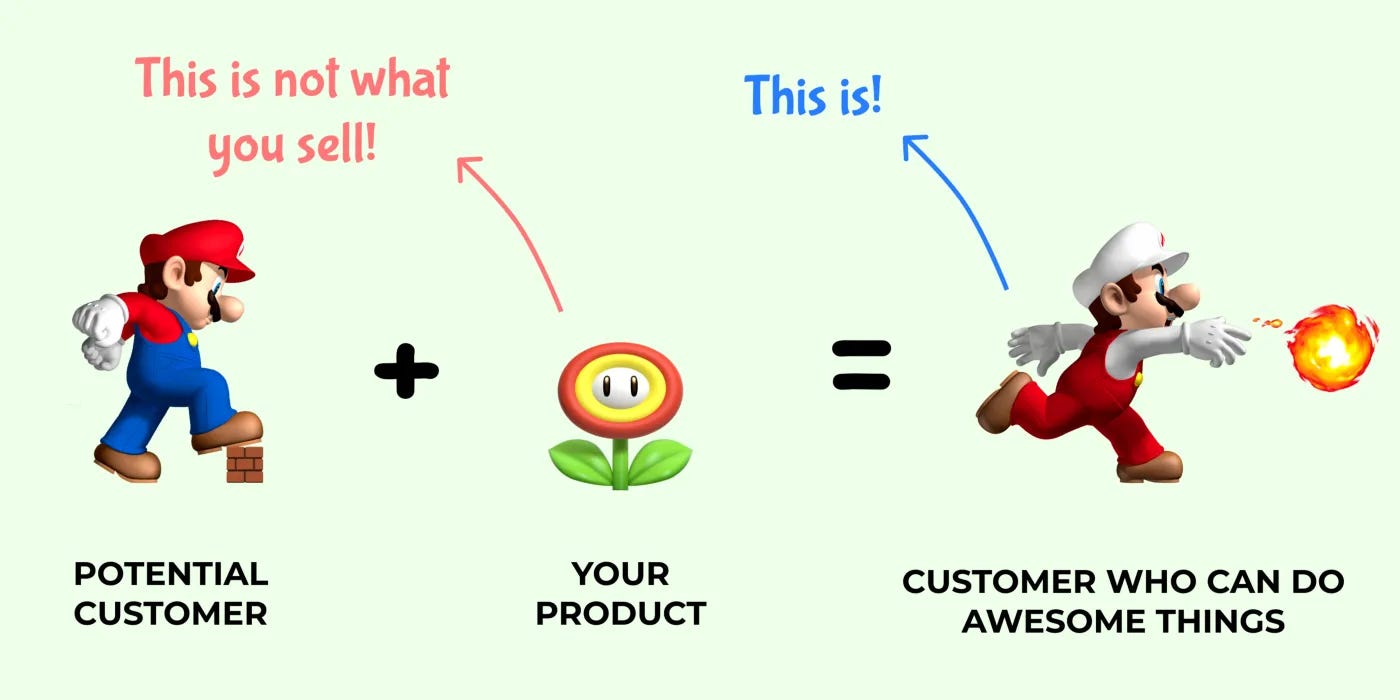
“No grades, no tests, no majors” is a description of the item, not the transformation. The student doesn’t care about the fire flower. They want to become Big Mario.
Hampshire keeps showing people the fire flower and wondering why enrollment is soft. We’re showing them the wrong thing.
I don’t just mean the school should talk more about alumni. They do sometimes show off our alumni, like biophysics alum Nicole DelRosso and neuroscience alum Talia Adi, though they could do it more. I mean that the school doesn’t make it clear what the model means for you as a prospective student; or what the model means for your child, as a parent. Stories of amazing alumni can help make the possibilities clear, but they’re not enough on their own, and it’s not enough to say, “look at our amazing alumni”.
Hampshire’s mistake has been selling their model as a model. They shouldn’t market on the basis of features of the model, like “no grades” and “no majors”. They should market the student who can do awesome things with the product, like publish original research before they’re 23.
I think this wraps up the whole problem very neatly. Hampshire has been selling the absence of constraints, which understandably leads to the slacker reading. We should be selling what happens when constraints are removed from a serious person. You need to remove constraints to get that, but “no constraints!” is the wrong message. It tells people that this is a place where you can do frivolous things with little to no accountability, so it’s no wonder that people think that Hampshire is a place where you can do frivolous things with little to no accountability.
Finally, I think the issues all come together in how Hampshire positions itself. I don’t know why we are the scrappy weird one. “More unconventional” is self-defeating, defining ourselves against someone else’s standard, not saying what we are, not even claiming a position, just saying how far we are from what we’re not. I prefer a vision that is not apologetic, and not just about being incoherently different. Let’s talk about the ways we’re better.
In fact, I think the message that Hampshire is the scrappy weird one is a lie. My experience has only ever been that Hampshire gave me a better education than anything else I have seen. When I took Behavioral Decision Making at UMass with Andrew Cohen, I remember he started the class by saying, “This isn’t going to be like your other classes. Each week we will read primary source research papers, there are no quizzes, and at the end of the semester, instead of a final exam, each of you will have to write an original research proposal. I hope you can handle it.” I sat there thinking, this is exactly the format of every course at Hampshire.

When I was getting my PhD at NYU, I found the PhD-level courses kind of boring, because we were doing the same things I had done in my Hampshire courses, except slower and with less pressure. Every week we would read two or three primary sources and then discuss them. I had already done that for many years as an undergrad.
So I don’t like the positioning of Hampshire as the underdog. We are not “disrupting higher education” like we are a gadfly or a jester. This is the superior model and the only sticking point is that for some reason we are shy to admit it.
This might seem like it’s a separate topic from fundraising to restore the school. But after my last piece, some people asked me, “How are you going to raise millions that Hampshire’s professional advancement staff couldn’t raise?”
My answer is because I will say: “This is the most powerful model in higher education and should be expanded immediately, so it can operate at full capacity kick Harvard’s ass”, instead of whatever the professional advancement staff said.
At baseline, Hampshire has a marketing problem. Which is fortunate, because I’m currently wrapping up a year as a Visiting Assistant Professor of Marketing at the University of Arizona. So let’s find a way to market our school in a way that conveys what is actually powerful about Hampshire’s model, and doesn’t sound like slacker handwaving or vague pamphlet cruft.
The New Pitch
I started by asking myself: What would you say to a brilliant 18-year-old who is choosing between Hampshire and Harvard?
I’d say, at Hampshire you’re treated as a scholar and given advanced classes right away, where you are expected to at minimum critique the work of others, but ideally produce your own.
The throughline is, “Hampshire is actually the most demanding model in American higher education, and here’s why”. In a slogan, it’s “Get in the arena right away.” This spirit is what unifies all the other parts of the model. The reason there are no grades, no departments, no requirements, is that they’re all mechanisms for keeping you out of the arena. Hampshire just removes them.
We need to learn how to convey that. We can’t focus on the features, like “no grades”. We can talk about average outcomes, like how many alums go on to get PhDs, but we can’t promise them. And we can’t guarantee specific things at the school aside from the model — we can’t necessarily say, “take MBA Negotiation”, because we may not offer that every year. We need to focus on the model.
We need to rebrand the model in terms of what it makes possible for the student. Not the features, not the outcome, not details that might change, the positive and specific things you can do with the model, and you can’t do at other schools. So instead of X, say Y:
No Grades
The main reason to nix grades is so you can focus on other things than min-maxing your GPA. But we’re looking for a positive vision, so we should make an argument for narrative evaluations. And we should follow Big Mario Marketing. What does this feature let students actually do?
The good news is that narrative evaluations are hugely undersold. A Hampshire transcript is an extraordinary document: a collection of four years of letters that describe your intellectual development. Instead of a number, a hiring manager or grad school gets a portrait of your abilities. One of my evals said, “Ethan writes like a second-year grad student.” I think this probably helped me get accepted to the PhD program at NYU.
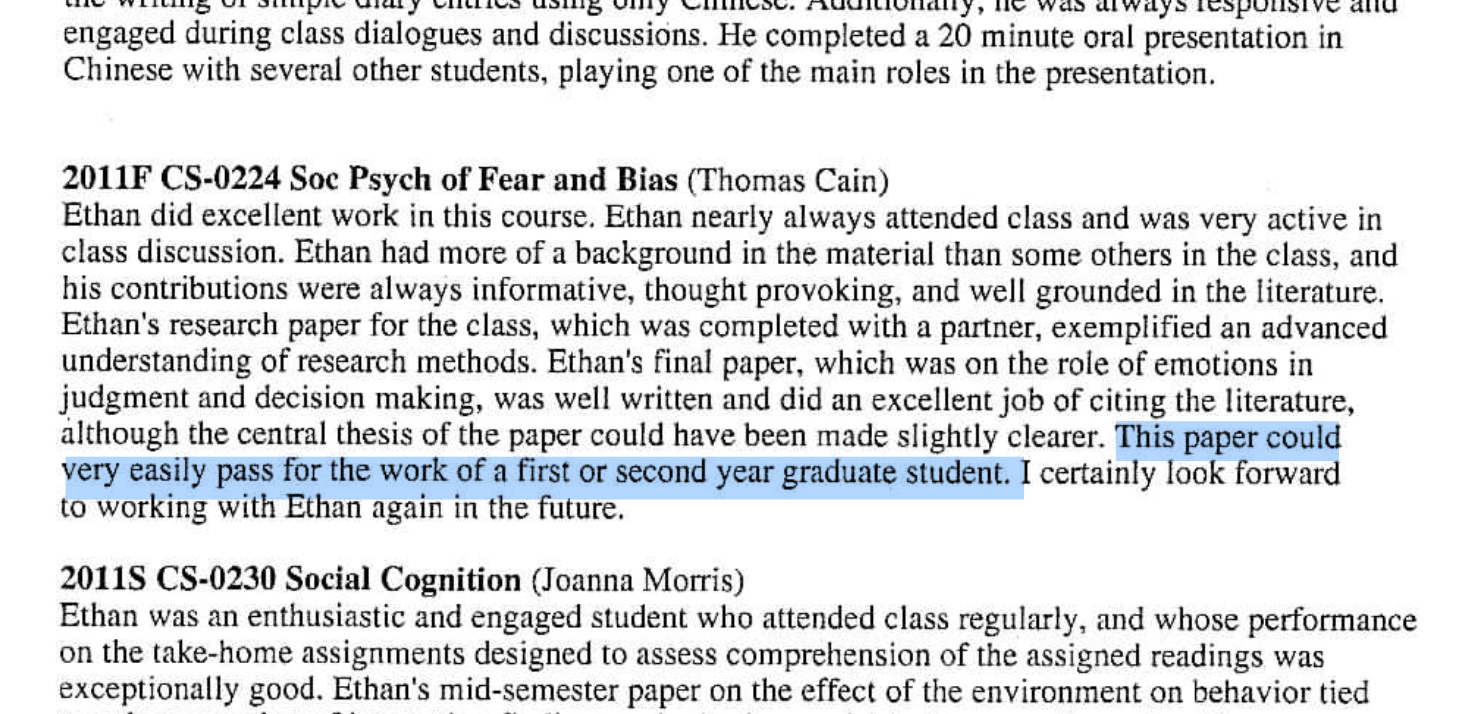
Nobody has marketed this properly, but describing it in detail might be all you need. So instead of saying no grades, say:
Every semester, each of your professors writes you a letter of recommendation about your actual work. Every semester for four years.
At the end of four years, you have a portfolio and a list of professional references who can describe your achievements.
Your education comes pre-endorsed, and makes a compelling argument to future employers and collaborators.
No Tests
Like grades, it’s tempting to point out that getting rid of tests is good because it gets rid of the dysfunction around tests. You can’t be cramming for the exam if there’s no exam.
This is good, but “think of all the things you will do with the time you save” risks sliding into sounding like, “we would rather be slacking off”. It’s lacking that positive vision. What does this feature let students actually do?

I think the solution is to focus on what you will spend that saved time creating. If necessary, you can pair that with the alternative as a foil: instead of cramming for the exam, instead of training to regurgitate, work on your projects instead. Instead of being judged on your performance under artificial pressure, get evaluated on your accomplishments. This might be ok for marketing materials, but we should still try to nail that positive vision.
So instead of saying no tests, say:
Get judged on your projects: your research proposal, album, short film, pop-up business, go-kart, or short story collection.
No Majors
Engineering students become engineers. That works well when thousands of slots are already predetermined and you can simply drop in.
Is that true anymore, for most people? I am skeptical that there are hundreds of these jobs in most fields any more. A friend of mine who attended Princeton before the 2008 financial crisis tells me that in his day, everyone graduated directly into a job in their field. I don’t think that happens any more, not even at Princeton. Most of my marketing seniors at Arizona, currently days from graduation, don’t have jobs lined up, and those that do have jobs lined up mostly don’t have them in marketing.
It’s a joke that these schools know what slots will exist in 5 years. There may have been a time in the 1950s and 1960s where a major would send you straight into a stable job. But no more, or at least, less and less. Even computer science as a major isn’t what it used to be. If these slots no longer exist, then majors make no sense, and Hampshire’s approach of skills and projects is the winning approach.
That said, I think even in a world with thousands of standardized job slots, there are still two reasons to prefer Hampshire’s model.
First, for all but the most boring jobs, the real requirement is always the same. You want someone who can think on their feet, make their own plans, make their own decisions.
Hampshire’s lack of majors encourages this kind of development. You can say “no majors”, but you can also say, “you’re on your own kid, you figure it out”. Those who are able to figure it out get a very good education indeed, in figuring it out. It’s harsh, it’s a little sink-or-swim, but it gets results. And you have a faculty advisor so you have someone to go to when you’re at risk of drowning.
“Meet with your advisor and choose what you want to study” risks coming off as soft, because having lists you’re not allowed to deviate from sounds “serious” I guess. But honestly, my time as an advisor was mostly spent trying to convince students to take fewer classes, so they wouldn’t burn themselves out. They really are disturbingly ambitious.
Second: majors don’t make sense if you want to do something unprecedented.
Majors might work for engineers or even economists. But if you want to create something new, whether that’s start a business, make a scientific discovery, or found a new artistic movement, no major can prepare you for that. If you want to fill in the details of someone else’s picture, a normal course of study may do it. If you aspire to see something no one else has seen or do something no one else has done — like be the next Katalin Karikó and bet your career on mRNA vaccines, an idea that the University of Pennsylvania deemed “not of faculty quality” — you will probably be better off with a unique course of study.
The vague pitch would be, “for people who want to do something original”. Words like “unprecedented” or “never before been seen” are better, but what we really want to capture is that while being trained in a canon or a skillset is useful, by itself that’s not going to create something the world hasn’t seen before.
So instead of saying no majors, say:
Take classes in whatever subject you like.
Take classes in as many subjects as you like.
Work on the frontiers of knowledge.
Find the open research questions not answered in your textbooks and work on solving them.
Find open research questions your professors don’t know the answer to.
Start your own business, newsletter, band, record label, or research program. Even if you run it into the ground, it’s yours.
Make your own way.
No Departments
Hampshire has no academic departments, but the main way it markets that feature is by saying the curriculum is “interdisciplinary”.
This is a marketing super-offender. Every school claims to be interdisciplinary, but why, and what does it mean? Mashing two fields together makes something interdisciplinary, but it doesn’t make it good.
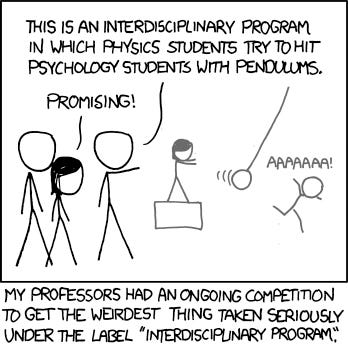
I think of the line, “The society that separates its scholars from its warriors will have its thinking done by cowards and its fighting done by fools.” (Not actually Thucydides, it’s Sir William Francis Butler.) But again, we have to be careful of vague clichés. I can already see some of you thinking, “well-rounded”.
At NYU there was a machine shop in the basement of the psychology building, packed literally wall-to-wall with machining equipment, so tightly that I had to hold my breath to slip through. Almost no one knew it was there. I was told that neuroscience graduate students were once required to machine their own probes, and went down to the basement themselves. Now they have to outsource this to the machinists in the basement who make the probes for them.
A lot is gained in specialization, but specialize too much and you lose contact with most of the world. College isn’t very long and the world is getting more complicated, so not everyone will learn Chinese or learn economics or learn how to weld. But if you don’t at least know someone who knows Chinese or knows economics or knows how to weld, I think you are separated from the world to a disturbing degree.
The positive version of “interdisciplinary” is that education should produce generalists. At risk of over-quoting this thing I always love to quote, from Robert A. Heinlein:
A human being should be able to change a diaper, plan an invasion, butcher a hog, conn a ship, design a building, write a sonnet, balance accounts, build a wall, set a bone, comfort the dying, take orders, give orders, cooperate, act alone, solve equations, analyse a new problem, pitch manure, program a computer, cook a tasty meal, fight efficiently, die gallantly. Specialization is for insects.
Read that list again and tell me, how many of those would you learn at a big state school? How many would you learn at the Ivies? How many would you learn at a standard small liberal arts school? And how many would you learn at Hampshire?
I like the idea of a society that produces adults where, if they find themselves in a position where some day they need to run a company or nonprofit; or repair a building; or advise an armed resistance; they could do it. So they should read Caesar and Clausewitz and they should study the campaigns of Alexander and Napoleon as part of their studies, or at least have the opportunity to do so. This is not a joke, this kind of thing used to happen:
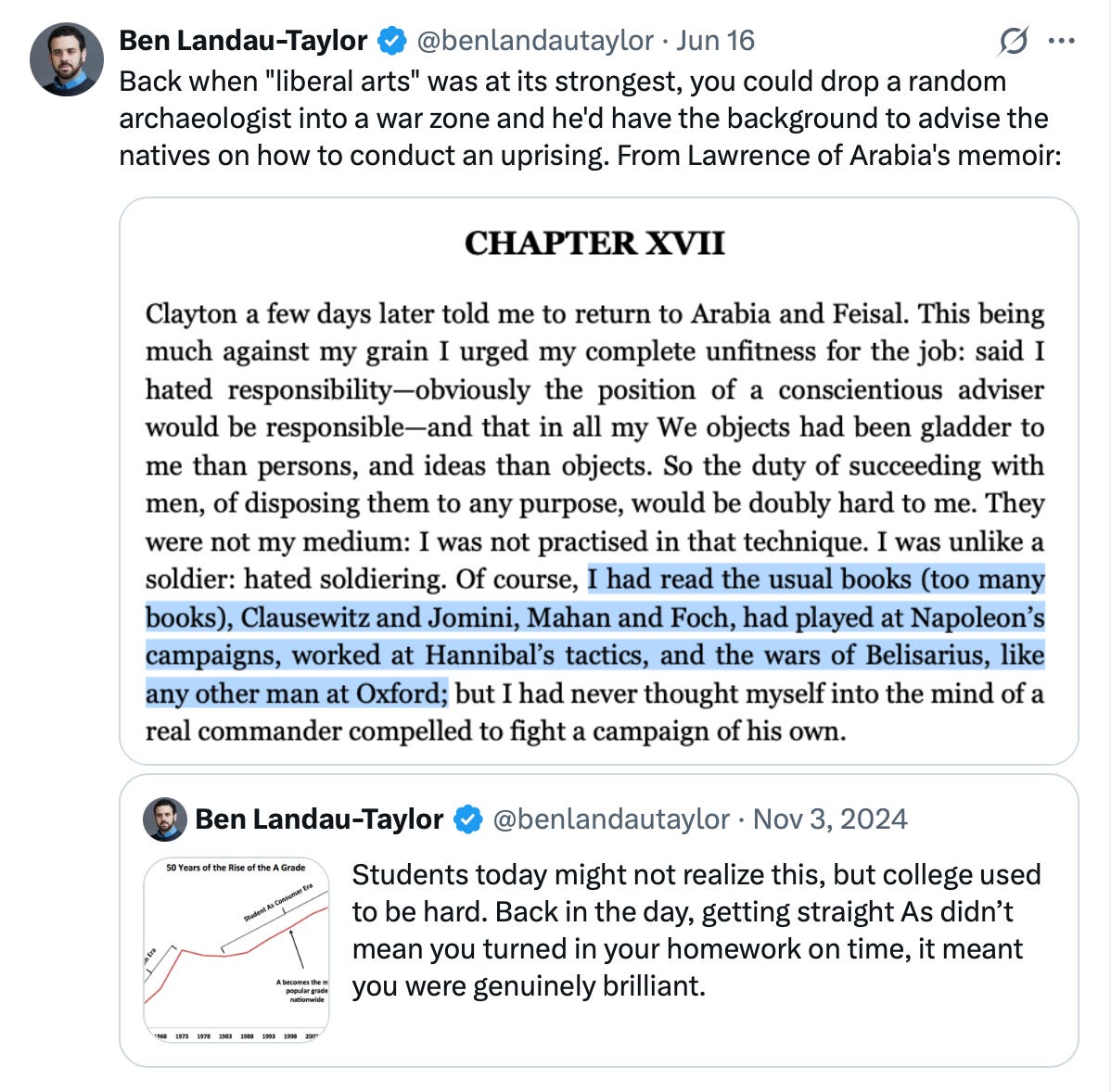
You may think that this would never fly at a bleeding-heart hippie school like Hampshire, but I remember many spirited Sun Tzu vs. Carl von Clausewitz debates that lasted late into the night during the Hampshire semester of Spring 2010.2 But as much as we debated these topics in the C1 Long Double, military history never made it into the curriculum, which is something the college ought to correct.
At its best, Hampshire produces people who can walk into a room of specialists and talk comfortably with all of them. So don’t talk about Hampshire’s lack of departments, and don’t call Hampshire interdisciplinary. Instead, say Hampshire trains generalists. Say:
The best problems don’t respect disciplinary boundaries. We don’t either.
Learn skills from many fields, because you never know what might be useful.
Learn as much as you can, because it’s good to be powerful.
You will have advisors from multiple fields, because real questions usually require that.
At most schools, talking to someone outside your department is extracurricular. Here it’s structural.
The problem you care about doesn’t care whether it’s philosophy or neuroscience, and neither should you.
Study problems, not departments.
[Entire Heinlein quote; maybe students should be required to memorize it.]
Specialization is for insects.
No Prerequisites
At a regular school, they’ll make you do boring shit for years before you get to do anything interesting.
You have to take lots of gen ed courses before you can even start taking courses in your major. You may not take serious courses in your major until Junior year, and you may not take any electives in your major until you’re a Senior. Why do my marketing students have to wait until they are seniors to take Digital Marketing? Why is Digital Marketing an elective for the marketing major? The mind reels.
There’s value in giving students a strong foundation, but there’s more value in letting them be as ambitious as they want. If I were in charge of the curriculum, I would do a lot to encourage students to get a solid background in their subject (more on this in a future piece). But as someone who always wanted to take more advanced classes in high school and middle school, and was always told that’s not allowed, I’m a hardliner on this issue. Students should be able to try as hard as they want.
Some of you might be wondering: if you can take 300-level classes right away, won’t students sign up for courses way too difficult for them, and fail spectacularly? Absolutely.
This is another benefit of evaluations over grades. If you try something really hard at Cornell and fail, you just nuked your GPA. Better stick to classes you know you can ace! How very ambitious of you.
If you try something really hard at Hampshire and fail, you get an eval that describes what happened. You failed, but it still might be very impressive.
Failure is part of the process of success. People get hung up on the word “failure”. Sounds scary. But the alternative is never playing at your level. If you’re winning every game, you’re in the wrong league.
Taking risks and failing, in school or anywhere, builds discipline and problem-solving abilities. I wish I had failed more in school. If you don’t have experience failing and regrouping in a safe environment like college, you will have a really hard time when you eventually fail in real life. We don’t normally use these terms in modern liberal arts education, but I think the opportunity to fail is good for your character. It gives you courage.
If we want students to grow up into adults who are ready to take risks and try ambitious things, we must make them comfortable with the possibility of failure. We should encourage them to try things at the edge of their abilities, we should underwrite smart risk-taking and experimentation.
So instead of no prerequisites, say:
Take the hardest courses you can manage.
Skip directly to 300-level classes.
Get treated as a scholar from day one.
Start doing real work immediately.
Take big risks.
Work at the limits of your abilities.
A school that isn’t afraid to let you fail.
Mandatory Senior Thesis
The mandatory senior thesis already sounds good and needs the least amount of rebranding, but I think we can punch it up even more.
This one also benefits a lot from comparison. In 2025 the Harvard Crimson published an opinion piece called Every Harvard Student Should Write a Thesis. This is how it opens:
When choosing a concentration in October of my sophomore year, I had a strategy: I would avoid any field that required a thesis. In my mind, writing at least 30 pages of original scholarship was too daunting to even attempt.
The author is a Harvard student, a double concentrator in Chemistry and History and Science. He goes on to describe the idea of writing a senior thesis as “(understandably) unbearable”. He worries that “the rigor of a thesis requirement would be overwhelming for ill-prepared [Harvard] students.” But having considered all these points, his recommendation is: “I have realized that for Harvard students to be truly competent in any area of study, we must be required to write a thesis. While learning the accepted facts of a field is indispensable, producing our own scholarship is the only way to demonstrate genuine mastery of a subject.”
So what is terrifying and aspirational to a Harvard student is normal and everyday to Hampshire students.
Princeton has a senior thesis requirement, where “almost every student at Princeton has to write a senior thesis in order to graduate.” But in the words of an alum on the admissions blog, “it’s basically just a long(er) research paper on a topic of your choice.” As far as I can tell, Princeton students continue to take a roughly normal courseload along with their senior thesis, while at Hampshire, the thesis is the main focus of an entire year. You have to take two course equivalents while working on these, but this is often covered by serving as a teaching assistant.
But in addition to taking pokes at the Ivies, we can also try to nail the positive vision. So in addition to saying every Hampshire student has to do a year-long senior thesis in order to graduate, say:
Every single graduate produces original work.
You cannot graduate without making a real intellectual contribution.
Every science undergraduate does original research.
The other aspect of the mandatory senior thesis is the mandatory senior thesis committee. This is a hidden gem, and most schools have nothing like it. The thing it most resembles is actually a PhD defense, where you have to defend your original scholarly work in front of a committee of faculty. Again, our grad school placement rate should be no surprise.
So instead of… not mentioning this part of the model at all… say:
The last thing you do at Hampshire is convince a room of serious scholars that your work is valuable.
Three faculty members read your work, challenge it, and sign off on it before you graduate.
Your thesis is defended in front of people who disagree with each other.
The New Elevator Pitch
So, imagine a school where each of your professors writes you a letter of recommendation every semester. Where you attempt ambitious projects and are judged on how well you can complete real work under real constraints. Where you can take classes in as many subjects as you like, and you’re encouraged to find and pursue open research questions your professors don’t know the answer to. Where you’re trained as a generalist, and learn how to talk to people outside your department. Where you’re allowed to take the hardest classes you can manage, and can skip directly to 300-level courses if you want, because you’re treated as a scholar from day one. Where they let you fail and let you make your own mistakes. Where a senior thesis is mandatory, you cannot graduate without making a real intellectual contribution, and you have to defend your contribution in front of a committee of college faculty. That’s Hampshire College.
Combining and synthesizing the best of the above, we get some pithy summaries. One, which I already mentioned, is “get in the arena”.
But another, interestingly, is “nowhere to hide”. This doesn’t fit quite with any one part of the model, because it fits with all of them. It works on about five levels simultaneously, which is rare for three words.
It describes the assessment model accurately. No grades means you can’t get a B+ and disappear. You cannot hide behind a number. You cannot be anonymous. Nowhere to hide.
It describes the thesis requirement. Before graduating, you have to stand in front of a faculty committee and defend original work, something you made. Nowhere to hide.
It describes the teaching and advising relationship. Your teachers know your abilities because they’ve seen your work. It’s not just the small class sizes; many liberal-arts colleges have small classes. It’s that in the absence of tests, professors had to assign you projects, and in the absence of grades, they had to judge that work on its merits, they couldn’t cram it into a rubric. So there are no formalisms separating you from the judgment of your professors. Nowhere to hide.
It reframes the “no requirements” feature correctly. Requirements are a hiding place. You fulfill the distribution boxes, you get your Bs, you graduate having never committed to anything in particular. With no majors and no requirements, our model removes these opportunities to hide. You must have a real intellectual project. You have to own it. Nowhere to hide.
It speaks to the anxiety and the appeal simultaneously. For a certain kind of student, “nowhere to hide” sounds like exactly what they’ve been waiting for. They’re sick of jumping through hoops that don’t mean anything, sick of being argued down when they try to do more, harder, actual work. For a parent, it sounds rigorous and demanding in exactly the right way. Nowhere to hide.
And it’s accurate. Many people do come to Hampshire expecting it to be a slacker school where they can coast, only to find themselves panicking as they must put together a course of study and justify it in a one-on-one meeting with a professor. And I’m happy to say that many people rise to the occasion and this experience turns them from a slacker into something more ambitious. But we should really make this clear in the marketing.
“Get in the arena” does similar work, but that’s more motivational, more about opportunity. “Nowhere to hide” is more structural, more about what the model actually guarantees. They might work together: Get in the arena. Nowhere to hide.
The New Marketing
We can now use these ideas to brainstorm lots of ads.
These are the marketing materials for the Hampshire I imagine. So by extension, they are marketing materials for the vision of the Hampshire I imagine. Share them and tell your friends. Actually, read them and tell me which ones are your favorite. Then tell your friends.
Ads for Students
Where are high school students coming from? You probably have a stereotype, and it’s probably somewhat unkind (more about this, perhaps, in a future piece). But in my experience, high school students want to work. Once it’s clear you are not going to be feeding them slop and busywork, many of them sign up for extra classes, harder classes, show up to class early, stay after class late. They want to do an independent study to learn Modern Greek. They want a challenge. Not all of them, but enough.
If they want less homework or less schoolwork, it’s often because they are learning the saxophone, or running the student paper, or trying to get a job. They are still hungry to do as much as possible. Hampshire can promise them exactly that.
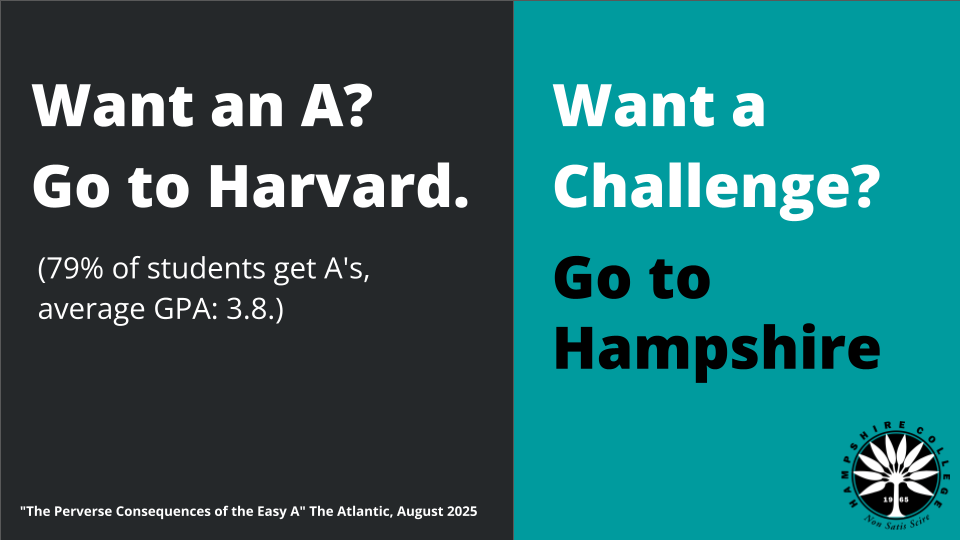
Want an A? Go to Harvard. (79% of students get A’s, average GPA: 3.8.) Want a challenge? Go to Hampshire.
Stay up late cramming for the exam working on your business model. HAMPSHIRE COLLEGE
Take advanced courses in your first year. HAMPSHIRE COLLEGE
Spend your college years in the lecture hall molecular bio lab. HAMPSHIRE COLLEGE
Report of the Classroom Social Compact Committee at Harvard, 2025: “A majority of students and faculty we heard from agree that Harvard College students do not prioritize their academic experience.” Wouldn’t you rather spend your time in a place where every student is doing original scholarship? HAMPSHIRE COLLEGE
Get evaluated on your work, not your performance under artificial pressure. HAMPSHIRE COLLEGE
The Atlantic (2025) on Harvard: “Students’ grades are up, but they’re doing less academic work. They skip class at a rate that surprises even the most hardened professors. Many care more about extracurriculars than coursework. … Can the world’s top universities get their students to care about learning?” Do original academic work at Hampshire College.
“Can you pass the exam?” vs. “Can you do the thing?” HAMPSHIRE COLLEGE
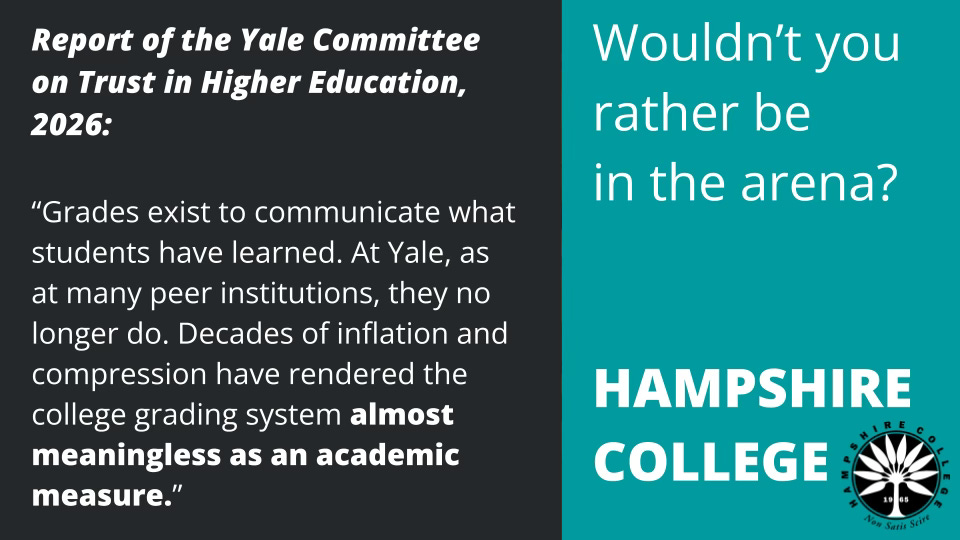
Report of the Yale Committee on Trust in Higher Education, 2026: “Grades exist to communicate what students have learned. At Yale, as at many peer institutions, they no longer do. Decades of inflation and compression have rendered the college grading system almost meaningless as an academic measure.” Wouldn’t you rather be in the arena? HAMPSHIRE COLLEGE
Afraid of writing a thesis? You’ll be in good company at Harvard. (The Harvard Crimson: “In my mind, writing at least 30 pages of original scholarship was too daunting to even attempt.”) Ready to produce original scholarship? It’s mandatory at Hampshire College.
Are you 18 years old and ready to do real scholarship? Most colleges will make you wait. (Ad copy: Maybe you’ve been reading Zhuangzi, or maybe you’ve been reading Ricardo. Maybe you’ve been assembling your own machine shop in your basement, or maybe you are recording demo tracks in your room. If you want to waste your youth in a lecture hall, how about Princeton or UCLA? If you want to take your original work and your scholarship to the next level, then how about Hampshire College?) HAMPSHIRE COLLEGE
At most universities, only 1 in 4 undergrads ever does real research. At Hampshire it’s a graduation requirement. Hampshire College. Get in the arena.
Are you 18 years old and ready to do real scholarship? Most colleges will make you wait. (Ad copy: Maybe you’ve been teaching yourself Mandarin. Maybe you’ve been building a compiler. Maybe you’ve been studying the migration patterns of monarch butterflies, or maybe you’ve been writing a novel in the back of your chemistry class. If you want to spend four years in a lecture hall, Princeton is right there. If you want to find out what you’re actually capable of, Hampshire College is waiting.) HAMPSHIRE COLLEGE
Can’t have grade inflation without grades. A school that lets you make your own mistakes. HAMPSHIRE COLLEGE
Are you 18 years old and ready to do real scholarship? Most colleges will make you wait. (Ad copy: Maybe you read every book on the syllabus before the semester started. Maybe you’ve been arguing with your professors. Maybe you’ve been running your own experiments, or publishing your own writing, or building something in your garage that nobody asked you to build. Most colleges will make you wait until junior year before they trust you with real work. Hampshire College will trust you on day one.) HAMPSHIRE COLLEGE
Every year there are a couple hundred kids who are ready to do original work at 18. Most of them will spend four years at large universities, invisible to each other, sweating over grades. Hampshire finds them and puts them in the same room. HAMPSHIRE COLLEGE
Are you 18 years old and ready to do real scholarship? Most colleges will make you wait. (Ad copy: Maybe you’ve been cold-emailing researchers whose papers you found on JSTOR. Maybe you’ve been sitting in lectures thinking, I could design a better version of this course. Maybe you’ve been learning limits and integrals off YouTube, because your school told you that you can’t take calculus until senior year. Most schools will ask you to slow down and take the prerequisites. Hampshire will ask what you need to go faster.) HAMPSHIRE COLLEGE
Hampshire College selects for a very specific kind of person. Serious, original, self-directed, slightly allergic to the credential machine. That person exists in every high school class, maybe one or two per school, but they’re dispersed, invisible to each other. Hampshire puts them in the same room.
Are you 18 years old and ready to do real scholarship? Most colleges will make you wait. (Ad copy: Maybe you’ve spent more time in the library than in class. Maybe you’ve spent more time in the garage than in the library. Maybe you’ve been writing code, or music, or proofs, and the idea of being forced to take a survey course on subjects you’ve already mastered makes you want to lie down on the floor. You don’t need a survey course. You need a room, a mentor, and people to argue with. Have you ever heard of a little place called Hampshire College?) HAMPSHIRE COLLEGE
Ready for a 600-person lecture? Go to UCLA. Ready for a graduate-level seminar? Go to Hampshire.
Are you 18 years old and ready to do real scholarship? Most colleges will make you wait. (Ad copy: Maybe you’ve been training a neural network on your laptop, or maybe you’ve been growing mycelia in your closet. Maybe you’ve been rewiring vintage synthesizers in your bedroom, or maybe you’ve been cataloguing beetles in your backyard. If you want four years of someone else telling you what’s worth studying, every other college is ready for you. If you want to forge your own path, Hampshire College is waiting.) HAMPSHIRE COLLEGE
Are you 18 years old and ready to do real scholarship? Most colleges will make you wait. (Ad copy: Maybe you’re the girl in your class who’s a little too obsessed with Napoleon. Maybe you’re the guy who’s always reading primary sources from McClintock, Levi-Montalcini, and Mary Somerville. Maybe you’ve been running fermentation experiments in your kitchen, or building analog circuits from schematics you found online. Follow the requirements for four years at another school. Maybe Penn. Or do the real thing at Hampshire College.) HAMPSHIRE COLLEGE

Ads for Parents
Let’s be real. Parents are making a lot of the decisions around college, and they’re a completely different audience. They’re not dreaming about intellectual freedom, they’re anxious about outcomes, wasted money, and whether their kid will be okay. The marketing needs to meet them there. Some of the ads above will work for both students and parents, but let’s write a few with the parents in mind.
The slacker framing is a really great way to discourage parents from sending their child to Hampshire. But at the same time, no parent believes their student should waste their time on busywork. Part of the messaging here is that the popular conception of higher education hasn’t caught up to reality. So let me tell you what’s going on at these big schools, even Harvard, Yale, Princeton.
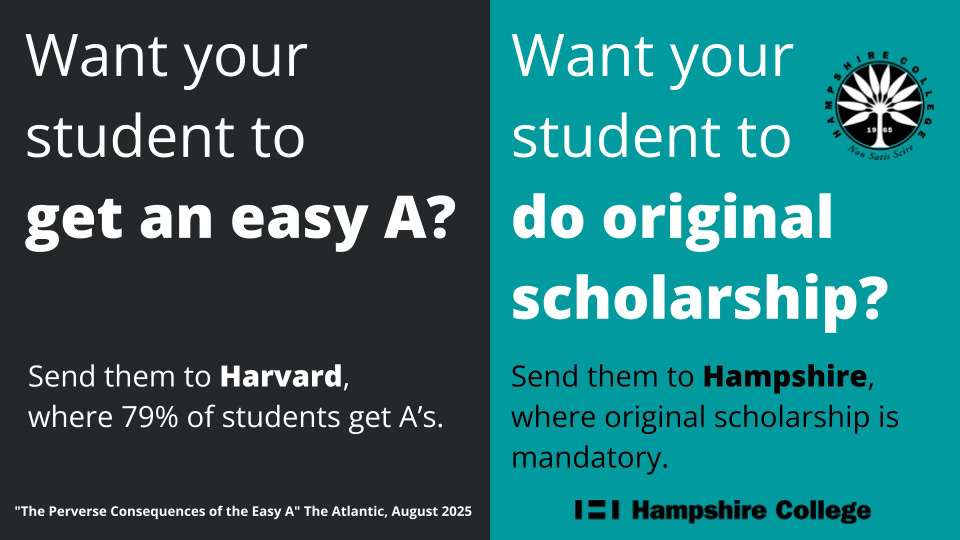
Want your student to get an easy A? Send them to Harvard, where 79% of students get A’s. Want them to do original scholarship? Send them to Hampshire.
At Hampshire College, every professor writes your student a letter of recommendation, every semester for four years. By graduation, your student has a portfolio and scholars who can vouch for them.
At Penn, your student will spend four years reading textbooks and checking distribution boxes. At Hampshire, they will spend four years reading primary sources and doing original scholarly work in their field. HAMPSHIRE COLLEGE
Hampshire College ranks top 40 nationally for PhD attainment. Every student must produce original scholarly work before they graduate. It’s mandatory.
Top universities give As to 80% of students. When your student graduates with a 3.8, what does that tell you, or them, or their future employer? Build your portfolio instead. HAMPSHIRE COLLEGE
At most schools your student can graduate without producing a single piece of original work. Not possible at Hampshire College.
Is your child smart, original, ambitious? Most schools don’t trust students with real intellectual work until junior year — if ever. HAMPSHIRE COLLEGE
Top 40 in the nation for PhD attainment. No multiple choice. Just real scholarship. HAMPSHIRE COLLEGE
1 in 20 Hampshire science students publish original research as an undergraduate. HAMPSHIRE COLLEGE
Or:
Your student is not average. You know that.
So why are you considering schools that will treat them like they are?
At many top universities, 79% of students get As. Students must complete distribution requirements before the institution trusts them with their own work. Sometimes their freshman schedule is pre-filled before they set foot on campus. At most universities, fewer than 1 in 4 undergrads ever does real research.
Hampshire requires a faculty advisor, original research, and a defended thesis to graduate — of every student. Not the honors students. Every student.
We trust your student on day one. We put them in the arena immediately. We let them fail, because that’s how people learn. And we evaluate them not with a number that 79% of their classmates share, but with a letter from a professor who has spent years training them.
Hampshire College. The education your student is ready for.
Not me by the way, I love wearing shoes.
For those wondering, I was on the Sun Tzu side of the debate, I find Clausewitz boring.
I wonder if instead of "generalists" it could be: "become a capable person, no matter what life throws your way".
The Heinlein quote is a favorite of mine. Wendell Berry also has a great one, let me see if I can find it...
Thanks for this deep dive into what Hampshire should have done. I (F80) graduated there some 30 years before you, but I recall making similar points about how Hampshire was entirely missing the point about how to sell their model.
Frankly (despite the flippancy that I write about this in my article), I tried to make many similar arguments as I toured students and families around campus in the early 1980s...with considerable success. Ultimately, some of us who still bother to think about it might figure out why Hampshire was so resistant to properly and effectively promoting its model. May there be something good that comes of that should this turn out to be the case.
https://jsunma.substack.com/p/finding-my-people
Being of a different generation (and we could go on about that forever), I took a very different approach to discussing my Hampshire experience and the benefits it brought to me, and I would contend most graduates.
Oh, and we both talked about the shoe thing.